

Most families don’t find out about adult activity centers at a relaxed moment, sitting down to research care options with a clear head and plenty of time. They find out when they’re already stretched. When the nights are interrupted and the days are consumed by caregiving responsibilities, something has to give.
If that’s where you are right now, you’re not alone. And the option we’re about to describe is one that most families in the Dallas-Fort Worth area don’t know exists until they’re exactly in that place.
An adult activity center is a structured, professionally staffed daytime program designed for older adults who benefit from support, engagement, and safe supervision during the day. It’s not a nursing home. It’s not in-home care. It’s a dignified, purposefully built environment where adults living with Alzheimer’s, dementia, and related memory conditions spend meaningful days with peers, receive the health and personal care they need, and return home to their families every evening.
This guide is for the family caregivers who are still in the early stages of figuring this out. It will answer the questions most people ask: what adult day services actually are, who they help, what a day looks like, how the costs compare to other options, and how to take the first step without feeling any pressure.
Friends Place Adult Day Services has been serving DFW families since 2005, with centers in Richardson, DeSoto, and a new third location in Plano. Everything in this guide reflects the real program, the real services, and the real experience of the families who have found us, many of them at exactly the moment you might be in right now.
The Weight Caregivers Carry
There’s a particular kind of exhaustion that comes with caring for someone you love who has Alzheimer’s or dementia. It’s not like being tired from a busy week. It doesn’t resolve with a good night’s sleep, which is often impossible anyway.
It’s the exhaustion of being the person who holds the whole thing together. The one who manages the medications, the appointments, and the routines. Who wakes up to confusion at 2 a.m. and gets up because someone has to. Who carries the worry quietly because there’s no one else to hand it to.
Most family caregivers do this for months or years before they let themselves seriously consider asking for help. Partly because they don’t know what help looks like. Partly because the options they’ve heard of, nursing homes, assisted living facilities, and full-time aides, don’t feel right yet. Partly because accepting support feels like a betrayal of the commitment they made.
It isn’t. Accepting support is often what allows you to keep the promise you made, to keep your loved one home, to stay present, to protect your own health enough to continue showing up.
Adult day services are the support most DFW families have never fully considered. And for many, it’s the thing that makes everything sustainable.
What Is an Adult Activity Center?
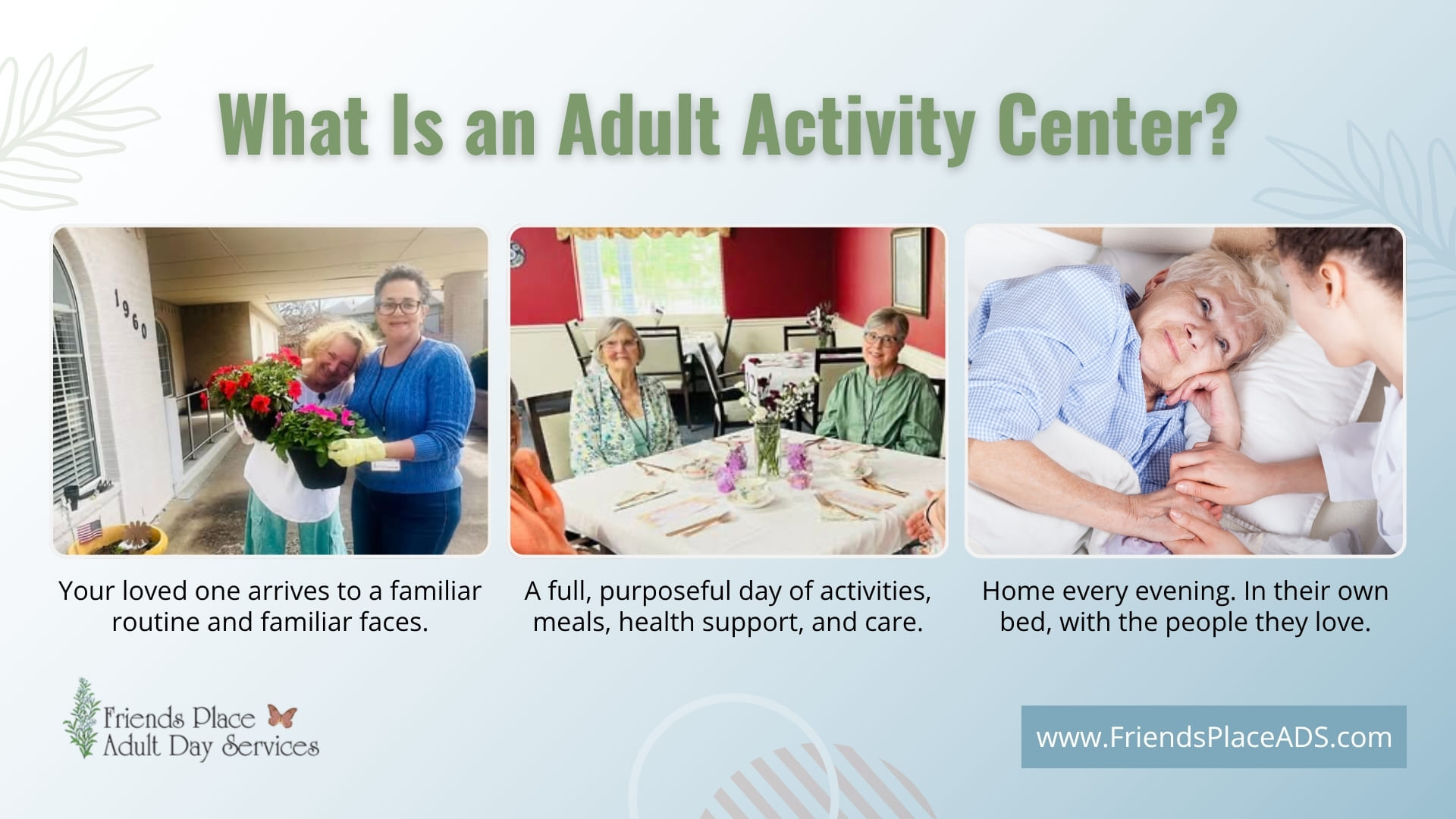
An adult activity center is a professionally staffed daytime program where older adults come during the day, participate in structured and purposeful activities, receive meals and health support, and return home to their families each evening.
Think of it as a community that exists for the hours between drop-off and pickup. Members arrive in the morning to familiar faces and a familiar routine. They spend the day engaged: in conversations, in music, in games, in movement, in personal care, in the quiet rhythm of a day that has been thoughtfully built around who they are and what they need.
At Friends Place, that program is designed specifically for adults living with early- and mid-stage Alzheimer’s, dementia, and related memory conditions. Not a general mix of seniors with a variety of needs, not a waiting room with activities added on, but a program purpose-built for the people it serves.
The staff knows each member’s name. They know which songs they respond to. They know how to redirect gently when anxiety rises and how to celebrate the small victories that matter every day. That consistency, that genuine familiarity, is part of what makes the program work.
And every evening, your loved one comes home. They sleep in their own bed, in the home they know, with the family they love. The program supports continuity rather than replacing it.
What an Adult Activity Center Is Not
Because adult activity centers are genuinely unfamiliar to most families, it helps to clear up what they aren’t before describing what they are.
Not a nursing home
A nursing home is a residential facility. Your loved one moves in and lives there around the clock. An adult activity center is not residential at all. Members come for the day and go home. The home life your family has built stays intact. The program is there to support it, not replace it.
Not a memory care facility
Memory care facilities are residential communities designed for people with dementia who need 24-hour supervised care. They’re appropriate for specific stages of the disease. An adult activity center like Friends Place serves adults in the early and mid stages of memory impairment, who still benefit from living at home and who thrive with structure, engagement, and the right level of support during the day.
Not a general senior center
Senior centers serve older adults broadly, often with drop-in, informal programming for a mix of participants with varying needs and abilities. A specialized adult activity center like Friends Place is purpose-built for people with memory impairment. The environment, the activities, the staff training, and the health support are all of it is designed around the specific realities of Alzheimer’s and dementia care. These are not the same experience.
Not in-home care
In-home care brings a caregiver to your loved one’s home, usually on a one-on-one basis. It’s valuable and the right fit for many situations. An adult activity center provides something different: a separate, professionally staffed community environment where members benefit from peer socialization, group programming, and a structured day that in-home care cannot replicate. Many families use both, and find the combination creates a genuinely sustainable caregiving approach.
Who Is the Right Fit for an Adult Activity Center?
The question most family caregivers ask first is whether their loved one is the right fit. Here is an honest answer.
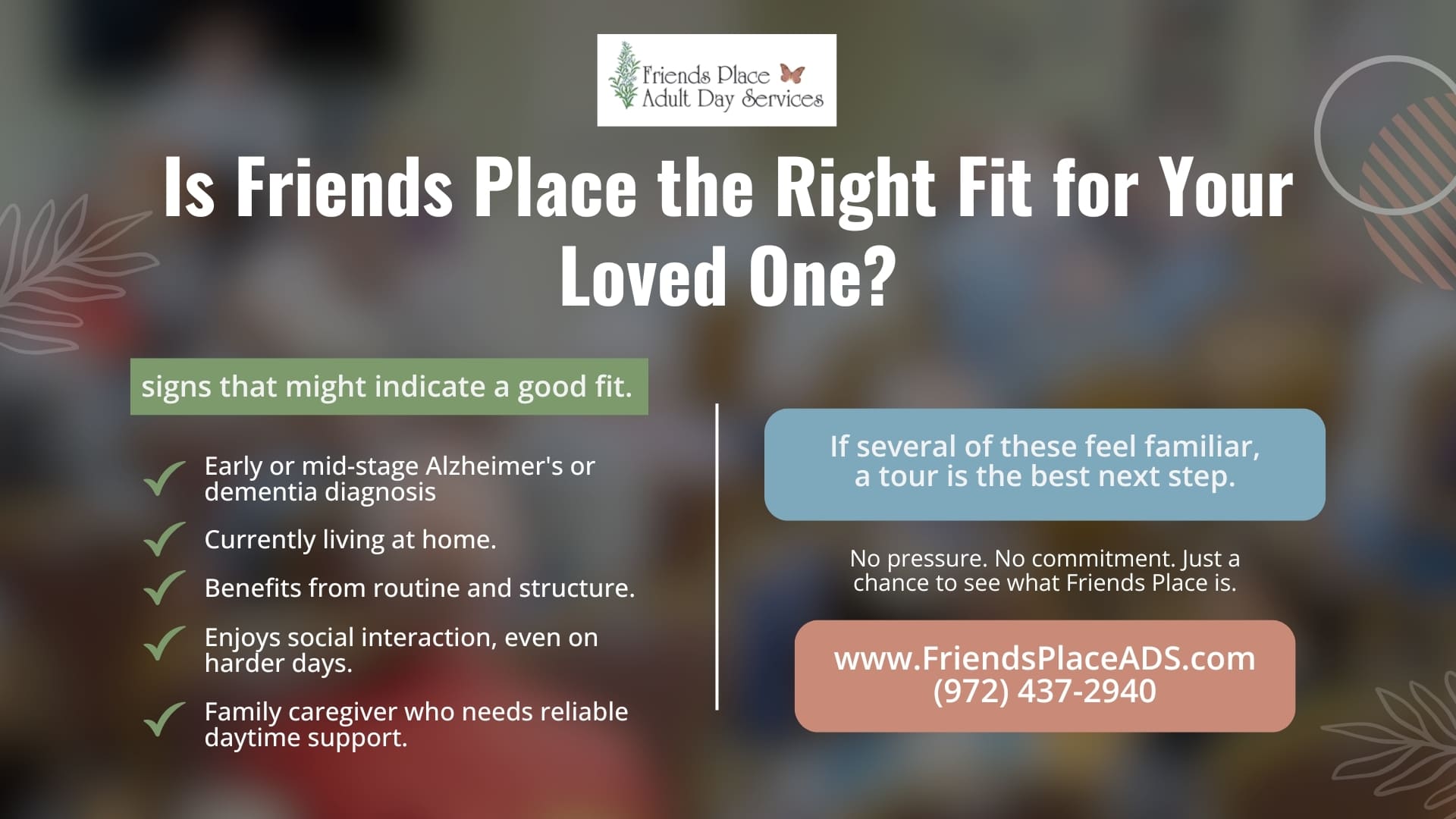
Friends Place is designed for adults who:
- Are living with early- or mid-stage Alzheimer’s, dementia, or a related memory condition
- Are ambulatory and able to participate in group activities, even with some support
- Are you living at home with a family caregiver or spouse
- Would benefit from a structured daily routine, social connection, and purposeful engagement
- Have a family caregiver who needs reliable daytime relief to maintain their own health, work, and wellbeing
If your loved one is in a later stage of the disease and requires around-the-clock residential care, a specialized dementia care facility may be the right fit at this time. Friends Place will always be honest with families about whether the program is the right match, and can help connect families with other resources if the timing isn’t right.
For families who are in the early or mid stages of the caregiving journey, and who are committed to keeping their loved one at home as long as possible, Friends Place is often exactly the support that makes that possible.
What Does a Typical Day Look Like at Friends Place?
This is the question that matters most to family caregivers, and the answer is one of the most important things we can share: a day at Friends Place is a genuinely good day.
Not a day of supervision. Not a day of waiting. A day that has been built around engagement, dignity, and the kind of moments that remind a person of who they are.
Arrival and Morning Welcome
Members arrive between 7:30 and 9:00 AM to a familiar welcome from staff who know them. This consistency matters more than it might seem. For adults with memory impairment, the predictability of a familiar face saying a familiar good morning is genuinely grounding. The morning begins with a continental breakfast and snacks. Health monitoring begins, blood pressure checks, glucose readings, medication administration, and oxygen support where needed. The routine of arrival sets the tone for the whole day.
Morning Activities
The morning activity block is designed to engage the mind and the spirit. Word games, trivia, and mind fitness exercises are woven into the morning alongside music programs and daily sing-alongs that tap into long-term memory in ways that are often deeply moving for both members and the staff who witness them. A daily sing-along might seem like a small thing from the outside. The experience of watching a loved one light up during a song they’ve known for fifty years is not small at all.
Exercise and Movement
Physical exercise happens twice daily at Friends Place, calibrated to each member’s ability level. Staying physically active is one of the most effective things an older adult with dementia can do to maintain function and quality of life. The program takes this seriously. Movement is built into the day, not added as an afterthought.
Lunch
A hot, nutritious lunch is served restaurant-style, prepared on-site, and reviewed by a licensed dietitian. Meals are not institutional. They’re planned thoughtfully, served with care, and eaten at tables with people around them. For many members, lunch is one of the social highlights of the day. Hydration is maintained throughout, with juices and water served regularly. Dietary needs and restrictions are accommodated.
Afternoon Programming
The afternoon offers a full mix of programming. Arts and crafts, book club, art appreciation, language class, and intergenerational programming bring different kinds of engagement to the day. Therapy dogs visit regularly. Community service projects and a participant volunteer program, which allow members to contribute their skills and time, provide something many older adults with dementia deeply miss: the feeling of being useful and of mattering to something beyond themselves.
Departure
Members are prepared for departure with the same care and familiarity that marked their arrival. Family caregivers receive updates on the day. Notes are shared about health observations, mood, engagement, and anything the staff thinks the family should know. Members return home having spent a full, genuinely meaningful day in good company.
The Activities: Why They’re Designed the Way They Are
It would be easy to look at a list of activities and see singing, crafts, and trivia as pleasant but not particularly significant. The reality is different.
The activity programming at Friends Place is intentionally designed around what research on dementia care consistently shows: structured, meaningful engagement helps maintain cognitive function, emotional regulation, social skills, and quality of life. This isn’t an activity for its own sake. It’s engagement as care.
Music reaches parts of the brain that Alzheimer’s often preserves long after other functions have been affected. A person who can’t recall what they had for breakfast may sing every word of a song from 1965 with complete clarity. The daily sing-along isn’t entertainment. It’s a connection.
Word games and mind fitness activities keep language pathways active. Community service projects and the participant volunteer program give members a sense of purpose and contribution that’s often among the first things lost after a diagnosis. The book club, the language class, and the art appreciation sessions maintain identity, keeping members connected to the people they have always been.
Exercising twice daily maintains mobility and physical strength, which directly affects independence and overall health. Therapy dog visits have been shown to reduce anxiety and improve mood. Intergenerational programming creates connections across ages that feel genuinely alive.
None of this is accidental. The program was built this way and continues this way because the people it serves deserve it.
Health and Wellness: What the Full-Time Nurse Means in Practice
One of the things that sets Friends Place apart from most adult activity centers is that a licensed nurse is on staff every single day.
Not on call. Not shared with another facility. On-site, every day, from open to close.
For families whose loved one has more complex health needs alongside their memory condition, this is not a minor detail. It means medication can be administered correctly and on schedule. It means blood pressure is monitored and documented. It means glucose levels are checked for members managing diabetes. It means oxygen support is available where indicated. It means that if something changes, medically, during the day, there is a qualified clinical professional on the premises who is already part of the member’s care.
Many families carry a quiet anxiety about leaving a loved one in someone else’s care, not because they doubt the warmth of the staff, but because of the medical complexity involved. The full-time nurse doesn’t eliminate that anxiety. But it changes the quality of the reassurance significantly.
Friends Place operates under a dual model: social and medical care under one roof. Most adult activity centers offer one or the other. Friends Place offers both. For families with loved ones who need both, this matters.
How an Adult Activity Center Supports the Whole Family
Adult day services are often described as a dual benefit, and that’s exactly right. The impact runs in two directions at once.
For the member
Older adults living with memory impairment who attend a specialized adult activity center consistently experience meaningful benefits over time. Reduced isolation. Improved mood and emotional regulation. Maintained cognitive function through consistent structured engagement. The experience of belonging to a community, of being known by name and genuinely welcomed each day. A social connection that in-home care cannot replicate.
What family caregivers often describe, sometimes with surprise, is seeing their loved one actually look forward to going. A member who was resistant to the idea in the beginning asked, on a Saturday, when they would get to go back. That shift, from reluctance to anticipation, happens more often than not when the environment is genuinely right.
For the family caregiver
The word respite is often used for adult day services, and it’s accurate as far as it goes. But the word undersells what’s actually happening for family caregivers who find the right program.
It’s not just rest. It’s the ability to sleep through a night knowing that tomorrow, the day is handled. It’s the ability to keep a job, or to go to a doctor’s appointment, or to have a conversation with a friend without the constant weight of monitoring. It’s the confidence that your loved one is having a good day, not just a safe one.
Many family caregivers describe the moment they started using Friends Place as the moment caregiving became sustainable again. Not easy. But sustainable. The difference between running on empty indefinitely and having a resource that lets you refill.
What Makes a Specialized Dementia Program Different
Not every adult activity center is the same. The distinction between a general adult activity center and a specialized dementia program matters enormously for families whose loved one has a specific diagnosis.
Friends Place is purpose-built for adults with Alzheimer’s, dementia, and related memory conditions. What that means in practice:
- The environment is designed with safety and predictability in mind, reducing confusion and supporting routine
- Every staff member is trained in dementia care, not just oversight
- Activity programming is calibrated to different stages of memory impairment, so early-stage and mid-stage members both participate meaningfully
- The 1:5 staff-to-member ratio means individual attention is genuinely possible throughout the day
- The full-time nurse brings clinical support that most activity centers don’t have
- The physical layout, the daily schedule, and the approach to redirection and de-escalation are all specific to the realities of dementia care
A general senior center can be a wonderful community. For an adult with Alzheimer’s or dementia, the wrong environment can actually increase distress. The specialization at Friends Place isn’t a marketing distinction. It’s the reason the program works the way it does.
How Adult Day Services Compare to Other Care Options
Most families exploring care options are weighing several things at once: what their loved one needs, what they can sustain as a caregiver, what they can afford, and what feels right. Here is an honest comparison of the main options.
Adult Activity Center vs. Assisted Living
Assisted living is the right choice when a person can no longer safely live at home, even with support, and when they need residential care around the clock. For adults in the early and mid stages of memory impairment, residential placement is often premature. It can be disorienting for the member; it removes the home environment that many people with dementia depend on for comfort and stability, and it typically costs significantly more.
Adult day services allow your loved one to remain in the home they know, with the routines and surroundings they depend on, while receiving professional support and genuine engagement during the day. Many families find that starting with Friends Place delays the need for residential placement, sometimes by years.
Adult Activity Center vs. In-Home Care
In-home care provides a caregiver in the person’s own residence, typically one-on-one. For adults with significant physical care needs, or for those who are not comfortable leaving home, in-home care may be the right primary option.
The meaningful distinction is that in-home care cannot provide what a specialized adult activity center provides: peer socialization, group programming, the cognitive engagement of a community environment, and the psychological benefits of belonging somewhere outside the home. Many families combine both approaches effectively: Friends Place for weekday daytime hours, in-home or family care for evenings and weekends.
Adult Activity Center vs. Memory Care Facility
Memory care facilities are specialized residential communities for people with dementia who need 24-hour supervised care and a secure environment. They’re the right choice when someone is no longer safe at home, even with robust daytime support.
Friends Place serves adults who are not at that stage yet and who benefit significantly from remaining at home. The goal of the program is, in part, to support the family through the early and mid stages of the disease in a way that delays or avoids residential placement for as long as it remains appropriate.
What Does an Adult Activity Center Cost in DFW?
Cost is one of the first real questions families ask, and it deserves a direct, honest answer.
At Friends Place, the daily rate is $80 for a half day, defined as five hours or less, and $100 for a full day, which is anything over five hours. These rates cover the full program: activities, meals, health monitoring by the full-time nurse, and personal care services.
For a family whose loved one attends five days per week, the monthly cost ranges from approximately $1,600 to $2,000, depending on full-day versus half-day attendance. That is a meaningful number, and we want to be straightforward about it. It is also significantly less than the cost of in-home care for equivalent hours, and substantially less than assisted living or memory care placement in the DFW area.
Long-term care insurance is accepted at Friends Place. If your loved one has a long-term care insurance policy, that coverage may apply to adult day services. It’s worth reviewing the policy or calling the insurer directly to confirm what’s covered.
For eligible veterans, both the Richardson and DeSoto centers hold contracts with the VA North Texas Health Care System, which may cover attendance at no cost. That benefit is described in more detail in the next section.
If cost is a concern, the most useful first step is a conversation with the Friends Place team. We can help you understand what options may be available and how to make the most of the resources your family already has.
What About Veterans?
Both the Friends Place Richardson and DeSoto centers hold contracts with the VA North Texas Health Care System. For veterans who are enrolled in VA healthcare and meet eligibility criteria, attending Friends Place may be covered at no cost or at significantly reduced cost.
This benefit is part of the VA Standard Medical Benefits Package and is specifically designed to support veterans who are living at home and benefit from structured daytime programming. Exactly what Friends Place provides.
If you are caring for a veteran with Alzheimer’s or dementia in the DFW area, we encourage you to call (972) 437-2940 or visit friendsplaceads.com to ask about VA eligibility. The first step is a conversation, and we’re glad to help your family understand what’s available.
How to Start Exploring: A First Tour at Friends Place
The best way to understand Friends Place is to see it. Not through a website or a brochure, but by walking through the door, meeting the staff, watching the day unfold, and feeling for yourself whether this is the right environment for your family.
A tour at Friends Place is unhurried. There’s no sales pressure, no enrollment pitch waiting at the end. The goal of a first visit is always the same: to give your family the information and the experience you need to make the right decision, whatever that turns out to be.
Many families find it helpful to bring their loved one on an early visit. The warmth of the welcome, the familiar sounds of music and activity, the comfort of a well-designed space, can ease the transition in ways that description alone can’t.
Before you visit, it can help to gather a few things:
- A summary of your loved one’s diagnosis, current stage, and any specific behavioral or health considerations the team should know about
- A sense of their interests, what activities they’ve always enjoyed, what music they love, what brings them to life
- Any questions you have about the nursing coverage, health monitoring, or personal care services
- Information about your insurance coverage, including any long-term care insurance policy and VA benefits if applicable
You don’t need to have answers to everything before calling. You don’t need to have made any decisions. You can call simply because you want to understand what this is, and whether it might be right for your family. That’s exactly what the first conversation is for.
Schedule a tour or reach out at friendsplaceads.com. Or call (972) 437-2940. We’re here.
FAQs: What DFW Caregivers Ask Most
An adult activity center is a professionally staffed daytime program for older adults who benefit from structured support, social engagement, health monitoring, and purposeful activity during the day. Friends Place specializes in adults living with Alzheimer’s, dementia, and related memory conditions. Members come for the day and return home each evening. The program is not residential.
Senior centers serve a broad range of older adults with informal, drop-in programming. A specialized adult activity center like Friends Place is purpose-built for adults with memory impairment, with dementia-trained staff, a full-time nurse, structured therapeutic programming, and an environment designed around the specific realities of Alzheimer’s and dementia care. The experience and the outcomes are meaningfully different for this population.
This is the question families ask most often, and the answer we hear most consistently from caregivers after the first few weeks is yes. The familiar staff, the structured routine, the activities calibrated to each member’s level of engagement, and the sense of belonging to a community create an experience most members genuinely look forward to. Connie Moss, a family member who shared her experience in a public Google review, described her loved one as having slid easily into a routine and attending daily since 2019. She added that if weekend services were offered, he’d be happy to go then too
Reluctance is common and completely understandable. Adults with memory impairment can resist change even when the change is beneficial, and the idea of going somewhere new may feel unsettling. The Friends Place team is experienced in supporting gentle, patient transitions. Many families find that bringing their loved one for a first visit, without framing it as a commitment, helps. Sitting in on the morning activities, meeting the staff, and experiencing the environment can shift the response significantly. We’re glad to talk through strategies for the specific situation your family is navigating.
At Friends Place, the daily rate is $80 for a half day (five hours or less) and $100 for a full day (over five hours). Long-term care insurance is accepted. For eligible veterans, both the Richardson and DeSoto centers hold contracts with the VA North Texas Health Care System, which may cover attendance at no cost. If you have questions about coverage, we encourage you to call (972) 437-2940 or visit friendsplaceads.com. The team is glad to help you work through the options.
The practical benefit is real and immediate: reliable daytime hours where someone you trust is responsible for your loved one’s care. Beyond that, many family caregivers describe a shift in the quality of their own days. The ability to sleep knowing tomorrow is handled. To keep working. To keep a doctor’s appointment. To be a person outside of caregiving. Staff shares daily updates at pickup so you always know how the day went. You’re not stepping away. You’re building a team.
Yes. Friends Place serves adults in both early and mid stages of Alzheimer’s and dementia, with activity programming calibrated to different levels of engagement. Early-stage members benefit from the cognitive stimulation, social connection, and structured routine in ways that can genuinely slow decline and support quality of life. Starting earlier, when the transition to the new environment is easier, often leads to a smoother experience for both the member and the family.
Friends Place currently operates in Richardson at 1960 Nantucket Drive and in DeSoto at 1232 W. Beltline Road. Our third location is in Plano at 4682 McDermott Road, expanding access across Collin County and North Dallas communities including Plano, Frisco, Allen, and McKinney. Visit friendsplaceads.com to learn more about each location or to schedule a tour.
Call (972) 437-2940 or visit friendsplaceads.com to schedule a tour. A tour takes about an hour. There is no pressure and no commitment required. You’ll meet the team, see the environment, and leave with a clear picture of whether Friends Place is the right fit. If you’d rather talk through questions before visiting, that conversation is welcome too. We’re here whenever you’re ready.