

A Note for the Caregiver Reading This
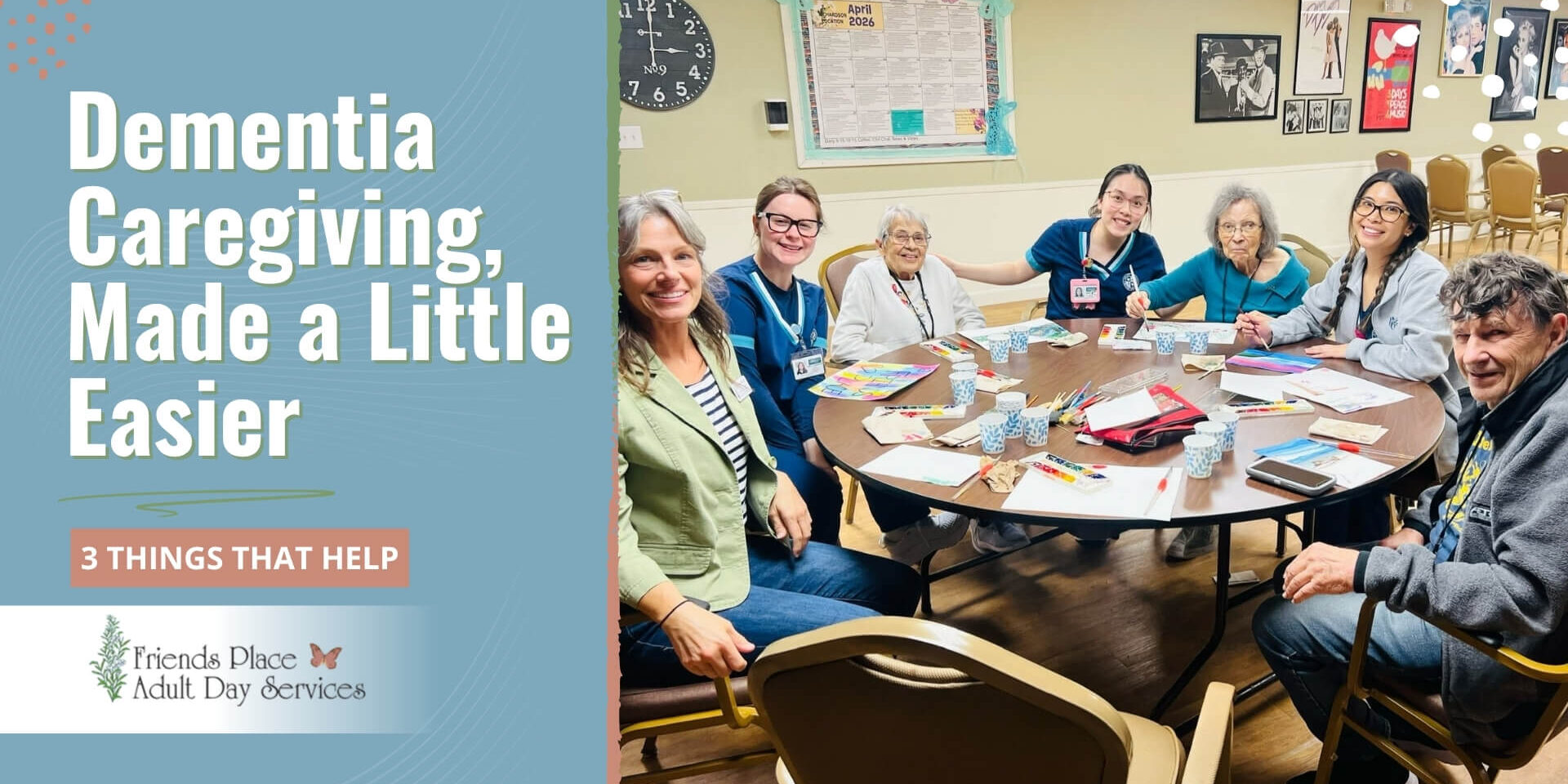
Caring for a loved one with Alzheimer’s or dementia at home is more manageable with three things: a steady daily routine, calm and simple communication, and real support so you aren’t carrying it alone. Adult day services like Friends Place Adult Day Services give your loved one meaningful, supervised days with university nursing students on staff, and give you a genuine break. To see if it fits your family, the simplest next step is to schedule a tour at friendsplaceads.com/schedule-a-tour.
You Are Not Alone in This
If you’re caring for a parent, a spouse, or another loved one living with Alzheimer’s or dementia, you’re doing one of the hardest and most loving jobs there is. It often arrives quietly. A little more help with appointments, a few more reminders, a watchful eye in the evenings, and then one day you realize you’ve become a caregiver, usually without anyone handing you a manual.
Across the Dallas-Fort Worth area, thousands of families are walking this same road, often feeling like they’re walking it by themselves. The exhaustion is real. So is the worry, the guilt, and the quiet grief of watching someone you love change. None of that means you’re doing it wrong. It means you care, and you’re human.
This guide is here to help. It pulls together practical, gentle approaches that make daily caregiving more manageable, the kind of guidance our team shares with families every week. It isn’t a list of rules, and it isn’t medical advice. It’s a steady, supportive starting point, with the reassurance that you don’t have to carry all of it on your own. When the day comes that you could use a real break, or your loved one would benefit from more connection and structure than home alone can offer, there are good options, and we’ll get to those too.
Read it from top to bottom, or jump to the part you need most today. However you got here, take a breath. You’re already doing more than you give yourself credit for.
Why Caring for Someone With Dementia Is So Demanding
Caregiving for any aging loved one is a lot. Dementia adds layers that can catch even devoted families off guard, and understanding why can take some of the self-blame out of the hard days.
The role changes constantly
Dementia is progressive, which means the person you’re caring for, and what they need from you, keeps shifting. An approach that worked beautifully last month may stop working, not because you failed, but because the condition moved. Good caregiving is less about getting it perfect and more about staying flexible and kind as things change.
It’s emotional as well as practical
You aren’t only managing medications, meals, and appointments. You’re also grieving small losses along the way and carrying feelings that rarely get talked about out loud: frustration in one moment, tenderness the next, guilt for both. Naming those feelings, rather than judging yourself for them, is part of staying well enough to keep going.
It can be isolating
Friends sometimes drift away because they don’t know what to say. Outings get harder to plan. The world narrows to the house and the next task. That isolation is one of the heaviest parts of caregiving, and it’s also one of the most fixable, which is much of what the rest of this guide is about.
If any of this sounds familiar, take it as a sign that what you’re feeling is normal and shared, not a personal shortcoming. The practical pieces below are meant to lighten the load a little, one habit at a time.
Understanding Early and Mid-Stage Dementia
You don’t need to be a clinician to care well, but a basic sense of how dementia tends to change over time helps you adjust your expectations and your approach. Dementia is an umbrella term for a decline in memory and thinking serious enough to affect daily life, and Alzheimer’s is the most common cause. It tends to move through broad stages, and what helps in one stage is often different from what helps in the next.
Early stage: independence with support
In the early stage, your loved one is often still quite independent. They may repeat questions, misplace things, lose track of dates, or struggle to find words, but they can usually manage much of daily life with reminders and a little structure. This is a meaningful window. Social connection, mental engagement, and physical activity all support wellbeing, and routines built now tend to carry forward as needs grow. It’s also a good time to plan together, while your loved one can share their wishes.
Middle stage: more hands-on help
The middle stage usually lasts the longest, and it’s when families feel the shift most. Memory gaps widen, confusion grows, and help with everyday tasks like dressing, bathing, and meals becomes part of the day. This is often when behaviors like restlessness, repetition, or late-day agitation appear, and when caregivers feel the load increase. It’s also the stage where structure, engagement, and outside support make the biggest difference, for the member and for the caregiver.
Wherever your loved one is on this path, the goal stays the same: support their dignity, meet them where they are, and protect your own wellbeing so you can keep going. The approaches in the rest of this guide work across stages, adjusted to fit the day in front of you.
Building a Daily Routine That Brings Calm
If there’s one change that helps almost every family, it’s a predictable daily rhythm. For a person with memory loss, the world can feel uncertain from moment to moment. A familiar routine answers the questions they may not be able to ask: what happens now, and what comes next, and that predictability tends to lower anxiety for everyone in the house.
Anchor the day with familiar landmarks
You don’t need a rigid schedule down to the minute. You need a few dependable anchors: waking and dressing around the same time, meals at steady hours, a regular afternoon activity, and a calm wind-down in the evening. When the bones of the day stay the same, the in-between moments feel less jarring.
Put demanding tasks in the best part of the day
Many people with dementia have a window, often the morning, when they’re most rested and engaged. Plan bathing, appointments, and anything that takes focus for that window when you can. Save the later hours, when fatigue sets in, for quieter, low-pressure activities.
Build in rest for both of you
A full day of stimulation can overwhelm someone with dementia and lead to agitation later. Plan gentle pauses, a rest after lunch, a quiet stretch with music. Those pauses are good for the caregiver too. You’re allowed to sit down.
A steady routine won’t erase the hard days, but it tends to make them fewer and softer. It’s also the same principle behind a structured day program, which is part of why so many members settle in and do well at a center with a consistent daily flow.
A sample gentle daily rhythm
Every family is different, and the point is steadiness, not a strict timetable. Still, a simple shape for the day can help you picture one. Many families find a rhythm like this works well:
- Morning: wake, dress, and eat breakfast around the same time, then tackle anything demanding while energy is highest.
- Late morning: an engaging activity, a walk, music, a hands-on task, or time with others.
- Midday: a calm, unhurried lunch with few distractions.
- Early afternoon: a rest or quiet time, then a second gentle activity.
- Late afternoon and evening: lower the demands, soften the lighting and noise, and move into a calm wind-down toward bedtime.
If a day goes sideways, and some will, you simply return to the rhythm the next day. The structure is there to lean on, not to fail at.
Communicating in a Way That Connects
As dementia progresses, words can become slippery, both finding them and following them. How you communicate often matters more than exactly what you say. A few gentle shifts can turn a frustrating exchange into a connected one.
Keep it simple and unhurried
- Use short sentences and one idea at a time. Ask one question, then wait longer than feels natural for an answer.
- Offer simple choices rather than open-ended questions. “Would you like the blue sweater or the gray one?” is easier than “What do you want to wear?”
- Lower your pace and your voice. A calm tone says more than the words do.
Meet them in their reality
When a loved one says something that isn’t accurate, the instinct is to correct them. With dementia, correcting usually causes distress without changing anything. It’s kinder, and far less stressful for both of you, to respond to the feeling underneath. If they’re looking for a parent who has passed, the need is comfort and safety, not the facts. Reassurance almost always lands better than a reminder.
Let your face and body do half the talking
A warm expression, eye contact, a gentle hand on the arm, and an unhurried posture communicate safety even when words fail. People with dementia often read emotional tone long after they struggle with language, so the calmer you appear, the calmer they’re likely to feel.
A few phrases that help
When you’re tired, it’s hard to find the right words in the moment. A small set of gentle, ready phrases can make hard exchanges easier:
- Instead of “Don’t you remember?” try “Let me help you with that.”
- Instead of correcting a wrong detail, try “Tell me more about that,” and follow the feeling.
- Instead of “You already asked me,” try answering simply again, then gently shifting to an activity.
- When they’re anxious, “You’re safe, I’m right here” often settles more than any explanation.
You won’t get it right every time, and that’s fine. The aim is connection, not a perfect script.
None of this comes naturally on a tired day, and you won’t do it perfectly. Even a few of these habits, used when you can, tend to make the whole house feel gentler.
Handling the Hard Moments With More Confidence
Certain situations come up often in dementia care. Knowing what’s behind them, and having a calm first move ready, takes away some of the helplessness when they happen.
Repeated questions
Hearing the same question for the tenth time is wearing, but for your loved one it may be the first time each time. Answer simply and warmly, and try a gentle redirection toward an activity or a snack. A written note in a visible spot can also ease repetition around a specific worry, like when a ride is coming.
Late-day restlessness, sometimes called sundowning
Many families notice more confusion or agitation in the late afternoon and early evening. It helps to lower the demands of that part of the day, close curtains before shadows grow long, turn on soft lighting, reduce noise, and offer a calming routine like familiar music or a simple shared task. A well-structured, active day often makes the evenings easier, since restlessness frequently follows a day with too little engagement.
Agitation or resistance
When a loved one becomes upset or refuses care, it’s usually communicating an unmet need: discomfort, fatigue, hunger, fear, or too much going on at once. Rather than pushing through, pause, lower the stimulation, check for the simple causes, and try again in a few minutes with a softer approach. Stepping back isn’t giving up; it’s often the fastest way through.
Walking and the urge to move
A desire to move or to leave is common and isn’t misbehavior. Safe movement is healthy, so where you can, create safe places to walk, secure exits gently, and offer a purposeful activity to channel the energy. If wandering becomes a safety concern, talk with your loved one’s doctor about practical safeguards.
When sleep gets turned around
Dementia can scramble the body’s sense of day and night, leaving a loved one up and restless after dark. Daylight and gentle activity during the day help reset the clock, as does limiting long late-day naps, caffeine, and heavy evening stimulation. Keep nighttime calm and dimly lit, and if sleep changes are sudden or severe, mention them to the doctor, since pain, medication, or other causes can be at work.
Resistance to bathing or changing clothes
Bathing is one of the most common flashpoints, often because it feels cold, exposing, or confusing. It helps to warm the room first, keep the steps simple and predictable, protect privacy and dignity, and offer choices where you can. If a particular time of day goes better, use it, and remember that a calm partial wash today beats a battle over a full bath.
Following you from room to room
Shadowing, when a loved one trails you closely or grows anxious the moment you step away, comes from a need for security, not a wish to crowd you. Reassurance, a familiar object, or a simple task to hold their attention can ease it. It’s also a clear sign of how much steady, engaged company helps, which is part of what a day program provides.
On the hardest days, remember that a difficult moment isn’t a verdict on your caregiving. You’re responding to a brain that’s changing, with a patience that few people are ever asked to summon. That’s something to be proud of, not to second-guess.
Meaningful Activities That Keep the Mind and Spirit Engaged
Engagement is one of the most powerful tools in dementia care. The right activities support memory, language, and mood, and they give your loved one something far better than empty hours: a sense of purpose and connection. The goal is enjoyment and dignity, not performance, so there’s no failing at an activity.
Lean on what they have always loved
A lifelong gardener may still light up sorting seeds or watering a plant. A musician may sing every word of a song they can’t otherwise recall. Familiar, long-held interests reach past the memory loss to the person who is still very much there.
Use music, movement, and the senses
- Music from their younger years can lift mood, spark memory, and calm agitation, sometimes when nothing else will.
- Gentle movement and daily exercise support sleep, mood, and physical health. Even a short walk or seated stretches help.
- Simple sensory and hands-on activities, folding towels, arranging flowers, looking through old photos, offer comfort and a feeling of usefulness.
Aim for connection, not correctness
Arts and crafts, word and trivia games, a sing-along, time with a friendly dog- these matter because of how they feel, not whether they’re done right. Shared laughter and a sense of belonging are the real outcomes.
Simple activities to try at home
- Sort, fold, or organize towels, socks, buttons, coins; calm, repetitive tasks that feel useful.
- Look through photo albums and tell the stories together, following wherever the memory leads.
- Play music from their teens and twenties, and hum or sing along.
- Tend a plant, snap beans, or help with a simple step of a meal.
- Take a short walk, do seated stretches, or toss a soft ball back and forth.
Keep it short, follow their lead, and let go of any idea of doing it correctly. If something brings a smile, it worked.
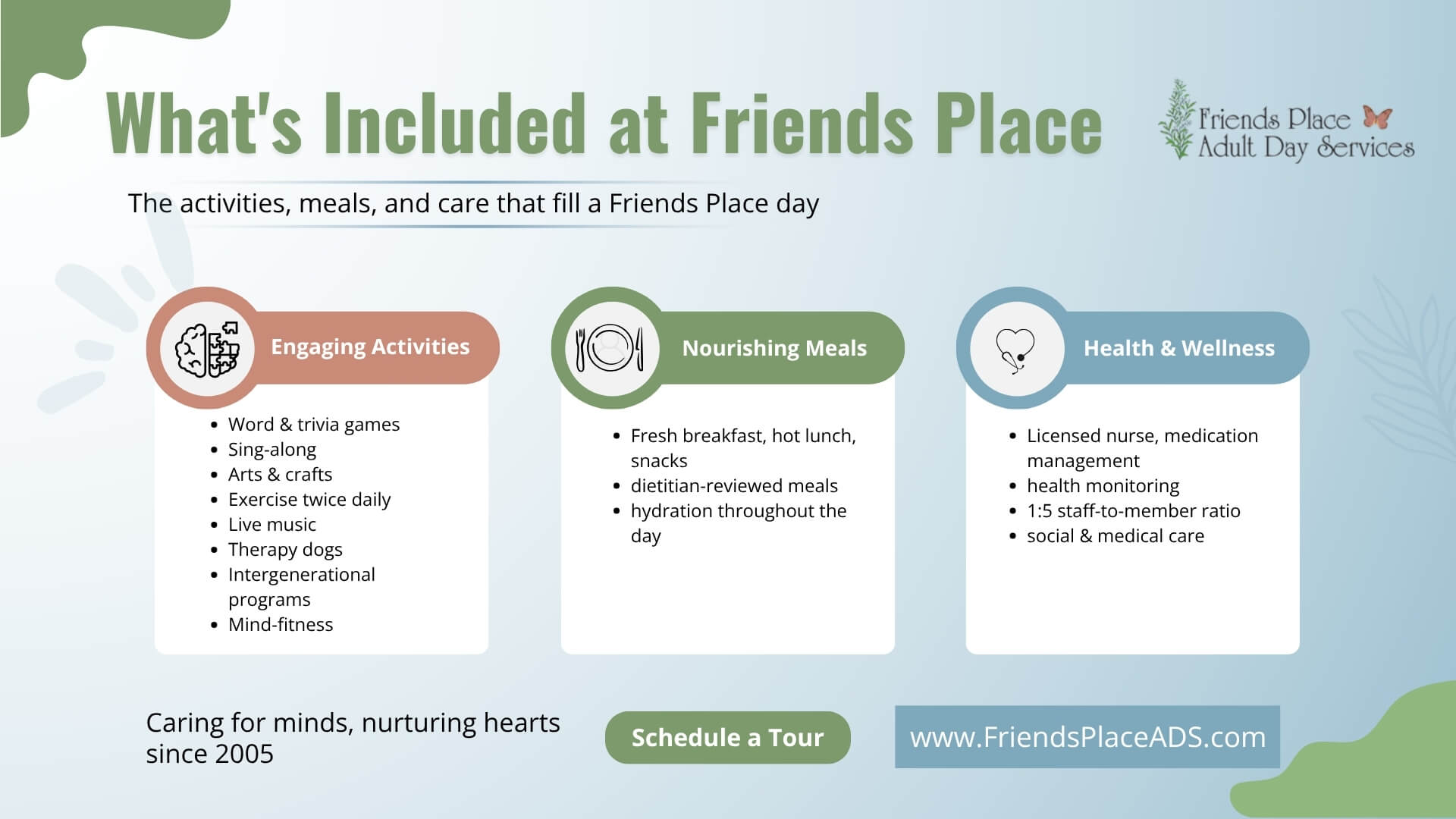
This is exactly the kind of programming a specialized day center is built around. At Friends Place, the day includes word and trivia games, daily sing-alongs, arts and crafts, exercise twice a day, musical programs with live entertainment, therapy dogs, intergenerational visits, and mind-fitness activities, all designed for connection and engagement. Families often tell us the variety is the difference, and it’s one reason a structured day can reach a loved one in ways a quiet day at home can’t. You can see it for yourself on a tour.
Everyday Safety, Health, and Nutrition at Home
A few practical supports protect your loved one’s wellbeing and your own peace of mind. None of this needs to happen all at once; pick what fits your situation now.
Make the home a little safer
- Reduce clutter and trip hazards, improve lighting, and add grab bars where footing is uncertain.
- Keep medications, cleaning products, and anything hazardous secured and out of reach.
- Consider simple labels or signs on doors and drawers to support independence and reduce frustration.
Stay on top of health quietly in the background
Medication management, blood pressure, hydration, and regular meals all play a larger role in mood and behavior than families expect. A dehydrated person, in pain, or off their medication schedule often becomes more confused or agitated, and the fix can be simple once you spot it. Keep a relationship with your loved one’s doctor, and don’t hesitate to ask whether a sudden change could have a physical cause.
Make meals and hydration easier
- Offer water and other fluids throughout the day, even without a request, since the sense of thirst can fade.
- Keep meals simple and familiar, reduce distractions at the table, and allow plenty of time.
- Watch for changes in appetite or swallowing, and raise them with the doctor.
When a change is worth a call to the doctor
A sudden shift in behavior, confusion, or alertness is worth a call, because it often has a treatable physical cause rather than the dementia itself. Watch for signs of pain, a possible infection (a urinary tract infection is a frequent and easily missed culprit in older adults), dehydration, constipation, or a reaction to a medication. Trust what you know about your loved one; if something seems off in a new way, it’s always reasonable to ask.
Handling all of this at home is doable, and it’s also a lot to hold by yourself, especially the clinical pieces.
Caring for Yourself Is Part of Caring for Them
Here’s the truth that caregivers most need to hear and least want to act on: you can’t pour from an empty cup. Your wellbeing isn’t a luxury or an afterthought. It’s the foundation that your loved one’s care is built on, and protecting it’s part of doing this well.
Caregiver burnout is real, and it isn’t a weakness
Exhaustion, irritability, trouble sleeping, frequent illness, sadness, and a sense of being numb or hopeless are signals that you’re running past empty. They aren’t character flaws. They’re your body and mind asking for support, the same way a warning light asks you to check the engine.
Let go of the guilt
Almost every caregiver feels guilty, for resting, for feeling frustrated, for wishing things were different, for considering outside help. That guilt is a sign of how much you care, but it isn’t a fact about your worth as a daughter, son, or spouse. Accepting help isn’t abandoning your loved one. Often it’s what allows you to keep showing up with patience and love.
Small acts of self-care add up
- Protect a little time that’s yours, even thirty minutes, and treat it as non-negotiable.
- Stay connected to at least one or two people you can be honest with.
- Tend to your own sleep, meals, and medical appointments- the basics you’d never let your loved one skip.
Looking after yourself isn’t selfish. It’s how this becomes sustainable, and how your loved one keeps the best version of you.
Building a Circle of Support
Dementia care was never meant to rest on one person’s shoulders. The families who do best are usually the ones who let others in, and there are more sources of help than most caregivers realize.
- Family and friends. People often want to help but don’t know how. Give them specific, doable tasks: a weekly grocery run, a Saturday visit, a few phone calls handled.
- Your loved one’s medical team. Doctors, neurologists, and university nursing students can guide care, adjust medications, and point you toward local resources. Bring your questions written down.
- Caregiver support groups. Talking with others who truly understand reduces isolation and is a place to trade practical tips. Many meet locally across DFW and online.
- Professional support and respite. Home health, adult day services, and respite programs exist precisely so families can keep a loved one at home longer without burning out.
DFW families also have local resources worth knowing about. The Alzheimer’s Association offers a 24-hour helpline, education, and free local support groups. Area agencies on aging can point you toward services and benefits in your county. Your loved one’s physician or a geriatric care manager can help coordinate the bigger picture. And adult day programs like ours are glad to be a resource even before you enroll; simply pick up the phone with a question. You don’t have to assemble all of this at once. One good connection often leads to the next.
Asking for help isn’t a failure of devotion. It’s one of the wisest, most loving moves a caregiver can make.
What Respite Care Really Means, and Why It Matters
Respite simply means a break for the caregiver, planned time when someone else provides safe, capable care so you can rest, work, run errands, see a doctor, or just breathe. It isn’t a sign that you’re giving up. It’s preventive maintenance for the person doing the caring.
Respite can look like a family member stepping in, an in-home aide for a few hours, or an adult day program your loved one attends during the day. The day-program version is one of the most sustainable, because it gives the caregiver regular, dependable hours back while giving the member something just as valuable: company, structure, and engagement that home alone can’t provide.
Families who build respite into their routine before they hit a wall tend to keep their loved one at home far longer, and to feel far more like themselves while doing it. Respite isn’t the last resort. Used early, it’s what makes the long road walkable.
How Adult Day Services Give You a Real Break
Adult day services are a daytime program where your loved one spends part or all of a day in a safe, engaging, supervised setting, then comes home to you in the evening. For many DFW families, it’s the missing piece that makes caring at home sustainable.
What your loved one gains
- Connection and friendship with peers, which eases the isolation of staying home.
- A structured, active day with cognitive and physical engagement designed for memory loss.
- Health monitoring from university nursing students on staff, and assistance with the day’s needs, handled with dignity.
- Nutritious meals and snacks, and a calm, predictable rhythm that supports better days and evenings.
What you gain
- Real, reliable hours back, to work, rest, run a household, or care for your own health.
- Peace of mind that your loved one is safe, supervised, and genuinely enjoying the day.
- A partner in the care, instead of carrying every hour alone.
It’s also a practical, affordable option compared with full-time placement, and for many families it’s what keeps a move to assisted living or memory care further down the road. That combination, better days for your loved one and a sustainable life for you, is the whole point.
What to Look for in a Dementia Day Program
If you decide to explore adult day services, not every program is the same, and knowing what to look for helps you choose with confidence. Whether you visit Friends Place or anywhere else, these are fair things to ask about and to feel out on a tour:
- A genuine memory-care focus. A program built specifically for Alzheimer’s and dementia, with a purpose-designed environment and dementia-trained staff, serves your loved one far better than a general senior center.
- A strong staff-to-member ratio and training. Ask how many staff are present per member, and what ongoing training they receive. More attentive, better-trained staff means safer, warmer days.
- Depth and variety of activities. Look for a full, varied day, cognitive games, music, movement, arts, and social connection, rather than a television in a quiet room.
- Safety, licensing, and nutrition. Confirm the center is licensed, that meals are nutritious and prepared on-site, and that the space is designed with safety and dignity in mind.
- Cost, insurance, and VA options. Understand the daily cost and what’s included, and ask about long-term care insurance and VA benefits for eligible veterans.
- How the place feels. Trust your instincts on a tour. Do members seem engaged and comfortable? Are staff warm? Can you picture your loved one belonging here?
Friends Place was built around every one of these: the memory-care focus, the university nursing students on staff, the trained team and 1:5 ratio, the deep activity program, the licensing and on-site meals, and the VA partnership for eligible veterans. The best way to judge any of it’s to come see a day in person.
Signs It May Be Time for More Support
There’s no single right moment, and asking for help sooner is rarely something families regret. Still, these are common signs that a little more support would help, for your loved one or for you:
- Days at home feel long and empty, and your loved one seems bored, withdrawn, or increasingly isolated.
- You’re exhausted, stretched thin, or noticing the signs of burnout in yourself.
- Safety is becoming a worry when you can’t be right there, or you’re afraid to leave the house.
- Managing medications, meals, or health needs at home is getting harder to keep up with.
- You’re starting to wonder whether you can keep doing this the way things are.
If you recognized your family in more than one of these, it isn’t a crisis, and it isn’t a failure. It’s simply information. A tour of a day program costs nothing and commits you to nothing, and it often brings real relief just to see a good option with your own eyes.
How Friends Place Helps Families
Friends Place Adult Day Services is a specialized daytime care center for adults living with Alzheimer’s, dementia, and other memory-related conditions. We were founded in Richardson in 2005 by a healthcare professional with more than 30 years in the field of aging, and caring for DFW families with warmth and dignity has been our whole purpose ever since.
From the start, the idea has been simple. Friends Place was created as a place for people with early and mid-stage Alzheimer’s to socialize with peers, keep their mind and body active, and stay independent in their own home longer. For families, it’s both meaningful adult day care and genuine respite, and a cost-effective alternative to nursing home care. The aim is to help your loved one maintain the best possible level of functioning and delay the need for a long-term care placement, so they can stay home and stay themselves, for as long as possible.
What sets the program apart is that it’s built specifically for memory care, not a general senior center. A university nursing student is on staff every day at each location to monitor health and manage medications, so families get both a social and a medical model of care under one roof. With a 1:5 staff-to-member ratio, dementia-trained team members, on-site meals reviewed by a licensed dietitian, and a hydration program throughout the day, your loved one is genuinely looked after.
We serve families across the Dallas-Fort Worth area from three centers in Richardson, DeSoto, and Plano. Our Richardson and DeSoto centers are contracted with the VA North Texas Health Care System, so eligible veterans can often attend at no cost. We’re licensed by the State of Texas, and care is affordable and flexible, at $80 for a half-day and $100 for a full day at our Richardson center, with long-term care insurance accepted.
Most of all, families tell us their loved ones are happy here, and that they themselves can finally exhale. That’s the difference a specialized day program makes: better days for your loved one, and a sustainable life for you.
Taking the First Step: A Tour
If anything in this guide spoke to where your family is right now, the kindest next step is simply to look. A tour lets you see the space, meet the team, and picture your loved one’s day, with no pressure and no obligation. Many families tell us the visit alone eased their worry.
Serving: Richardson, DeSoto, Plano, Dallas, Garland, Mesquite, Duncanville, Cedar Hill, Lancaster, The Colony, Frisco, Allen, McKinney, and the surrounding DFW area.
Adult day care is a supervised daytime program for older adults who need companionship, engagement, or assistance during the day. Friends Place specializes in care for adults with Alzheimer’s and dementia, with structured activities, on-site meals, health monitoring from a university nursing student, and socialization in a safe, purpose-built setting. That memory-care focus, and the university nursing students on staff every day, is what sets it apart from a general senior center.
No. The program is designed primarily for adults with memory problems, but a formal diagnosis isn’t required. Adults with Parkinson’s, mild cognitive impairment, and other older adults also benefit from the cognitive and physical wellness activities. If you’re unsure whether it’s a fit, a tour and a brief assessment will help you decide.
At our Richardson center, Friends Place is $80 for a half day (five hours or less) and $100 for a full day (over five hours), with a one-time $65 enrollment fee. Long-term care insurance is accepted, and for eligible veterans, VA benefits may cover the full cost. It’s a far more affordable option than full-time assisted living or memory care.
A typical day blends engagement and rest: word and trivia games, a daily sing-along, arts and crafts, exercise twice a day, musical programs, therapy dog visits, and mind-fitness activities, along with a light breakfast, a hot lunch, and snacks. The day follows a calm, predictable rhythm that tends to support better moods and easier evenings.
Yes. Friends Place is flexible. Members can attend for any five hours during operating hours with a reservation, and you choose the days that work for your family. Reservations help the team plan meals, staffing, and the 1:5 ratio. Drop-in isn’t offered, but same-day reservations can often be accommodated.
Yes. Both the Richardson and DeSoto centers are contracted with the VA North Texas Health Care System through the VA Community Adult Day Health Care Program. Eligible veterans can often attend at no cost, though a small copay applies in some cases. Our team can help you determine eligibility.
Yes. A light breakfast, a full hot lunch, and planned snacks are included in the daily fee, all prepared fresh on-site and reviewed by a licensed dietitian. Special diets, food restrictions, and individual preferences are accommodated, and hydration is offered throughout the day.
Friends Place has centers in Richardson, DeSoto, and Plano. We serve families across the DFW area, including Richardson, DeSoto, Plano, Dallas, Garland, Mesquite, Duncanville, Cedar Hill, Lancaster, The Colony, Frisco, Allen, and McKinney.
Start by scheduling a tour at friendsplaceads.com/schedule-a-tour, or give your nearest center a call. You’ll see the space and meet the team, then bring your loved one for a short second visit and a brief assessment, complete enrollment, and choose a start date and days. There’s no pressure, and the tour alone often brings families real peace of mind.