


Respite care for dementia caregivers is any planned break where someone else safely looks after your person so you can rest, work, or simply leave the house. Around Dallas, it comes in three shapes: help at home, a day program, or a short overnight stay. The right one depends on how long a break you need and which county your loved one lives in, because that decides which public agency answers your call.
TL;DR
Respite is short-term relief for a family caregiver. The National Institute on Aging describes it as lasting anywhere from a few hours to several weeks, delivered at home, in a health care facility, or at an adult day center. For someone living with dementia, the setting matters as much as the hours, since routine and familiar faces carry a lot of weight.
North Texas has two public entry points: the Dallas Area Agency on Aging for Dallas County residents, and the North Central Texas Area Agency on Aging for Collin, Ellis, and eleven other counties. Texas Health and Human Services runs a searchable respite directory, but it states plainly that a listing is not an endorsement or a licensing check. Weekday day programs cover a regular break; nights, weekends, and holidays need a second plan.
What Counts as Respite Care for Dementia Caregivers?
Respite is care that exists for the caregiver’s sake: a planned block of time when a capable person takes over so the primary caregiver can step away. The National Institute on Aging’s page on respite care says it can last a few hours or several weeks and can happen at home, in a health care facility, or at an adult day center.
That definition is broad on purpose.
A neighbor who sits with your husband on Tuesday afternoons is respite. So is a paid aide, a day program three mornings a week, or a five-night stay at a licensed facility while you recover from surgery.
What changes with dementia is the cost of disruption, and that changes the whole calculation.
A new face at the door or a new building can unsettle someone for the rest of the day, so the gentlest option is often the one that repeats on a schedule. A single dramatic break can be harder on both of you than a small one that happens every week.
| Setting | Typical length of break | Who usually provides it | What to weigh for dementia |
|---|---|---|---|
| At home | A few hours to a full day | Family, friends, volunteers, or a paid aide | Familiar surroundings, but a stranger in the house |
| Adult day center | Part or all of a weekday | Trained staff in a group program | New building at first, then a steady routine with peers |
| Overnight facility stay | One night to several weeks | Assisted living, nursing facility or hospice | Longest break, biggest change of surroundings |
The NIA page also covers the money side in two lines worth knowing. Help from friends, relatives, or volunteers may cost nothing, while professional services charge by the hour, day, or week. Most private health insurance does not pay for respite, though some long-term care policies do.
How Long a Break Do You Need This Month?
Start with the length of the break, not the provider.
A caregiver who needs two free afternoons a week needs a different arrangement from one who has a wedding in Houston next month, and both differ from someone who needs a full night of sleep. Write down the hours before you call anyone, because every provider will ask.
A simple way to sort it:
- A few hours, once or twice a week: Errands, a doctor’s appointment of your own, a haircut. In-home help or a half day at a center both fit.
- Most of a weekday, on a schedule: Holding down a job, or just getting the house back to yourself. This is what adult day programs are built around.
- Evenings and weekends: Day centers are closed, so this is family, volunteers, or an in-home aide.
- Several days away: Travel, a hospital stay of your own, or real rest. This means an overnight setting.
When the answer is a few hours, twice a week
Short breaks are where family and friends help most, and where many caregivers never ask. The NIA’s advice is practical: ask for small things first, send a text if asking face to face is hard, and match the request to the person’s skills. Your brother in Garland may be hopeless with meals but perfectly happy to watch the ballgame with Dad for three hours.
Keep the handoff consistent when you can.
The same helper, the same afternoon, and the same activity make the change of company easier for someone with memory loss.
When you need several nights away
Overnight respite usually means a short stay at an assisted living community or nursing facility that accepts respite guests. Ask about the length of stay they accept, what paperwork they need from the doctor, and whether memory care staff will be with your loved one or only general staff.
One exception is worth knowing.
For a person already receiving hospice care, the NIA notes that Medicare covers most of the cost of up to five consecutive days of respite in a hospital or skilled nursing facility. Outside hospice, that benefit does not apply.
Which Agency Answers Depends on the County Line
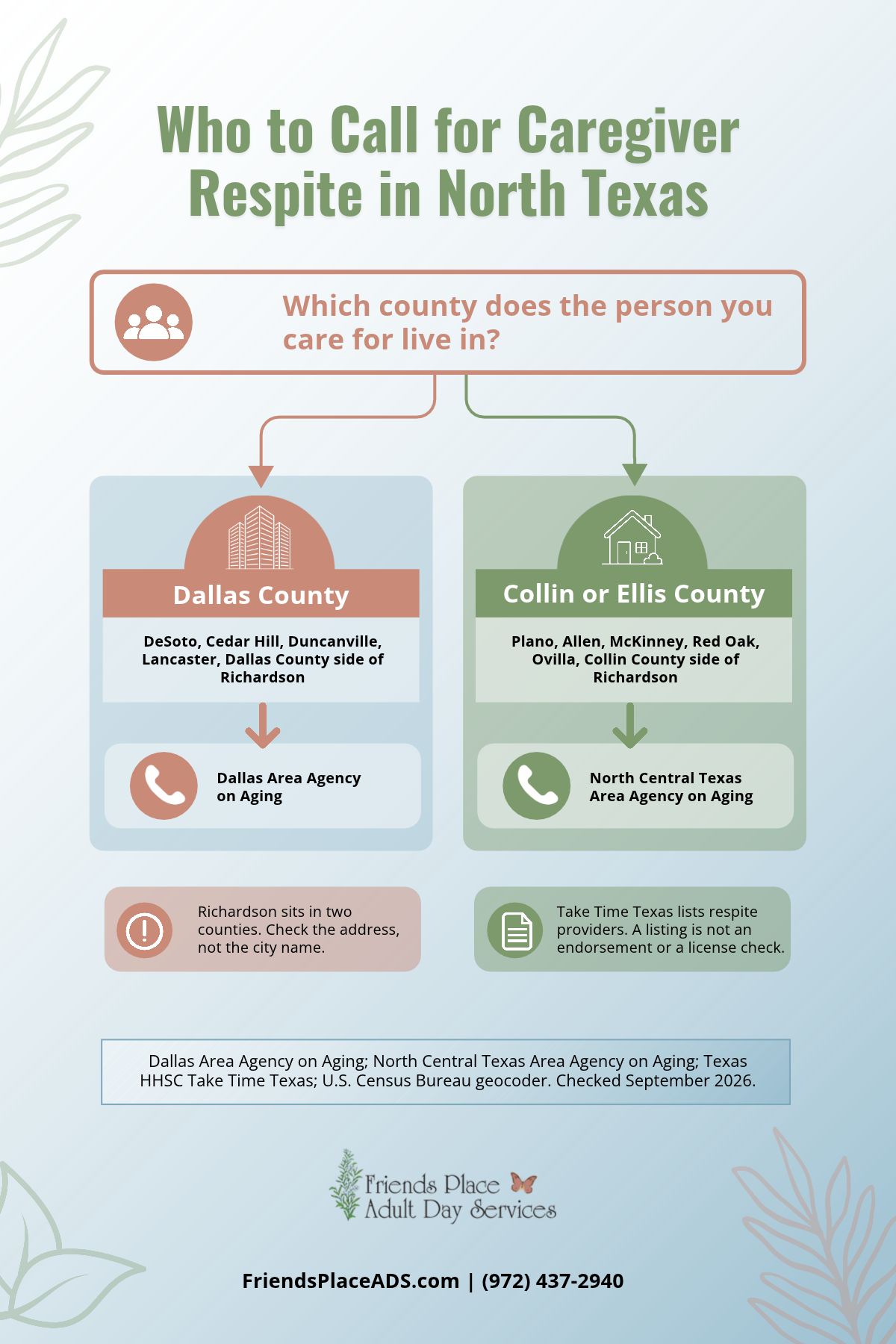
Here is the local detail that trips up families on our side of the metroplex. Public caregiver support in North Texas is split by county, and the city on your mailing address does not always tell you which county you are in.
Richardson is the clearest case. The city sits in both Dallas County and Collin County, and the line runs through town.
By the U.S. Census Bureau’s geocoder, 411 West Arapaho Road near downtown Richardson is in Dallas County, while 3301 Breckinridge Boulevard in the 75082 ZIP code is in Collin County. Our Richardson center on Nantucket Drive geocodes to Dallas County, but plenty of the families who drive to us live on the Collin side, or farther north in Plano, Allen, and McKinney.
The same thing happens south of our DeSoto center. DeSoto, Cedar Hill, Duncanville and Lancaster are Dallas County towns, while nearby Red Oak and Ovilla geocode to Ellis County.
| If the person you care for lives in | The public agency to call | Its caregiver residency rule, as published |
|---|---|---|
| Dallas County (DeSoto, Cedar Hill, Duncanville, Lancaster, the Dallas County side of Richardson, Dallas) | Dallas Area Agency on Aging | The care recipient must live in Dallas County |
| Collin County (Plano, Allen, McKinney, the Collin County side of Richardson) | North Central Texas Area Agency on Aging | Either the caregiver or the care recipient lives in one of its 14 counties |
| Ellis County (Red Oak, Ovilla) | North Central Texas Area Agency on Aging | Same rule as above |
What each agency says it offers
The Dallas Area Agency on Aging, a program of the Community Council of Greater Dallas, lists caregiver support that includes respite care, with specialized support for caregivers of people with Alzheimer’s or dementia. Its published rules say the caregiver cannot be paid for the care, and the caregiver must be looking after someone 60 or older or someone of any age with Alzheimer’s or a related dementia.
The North Central Texas Area Agency on Aging caregiver support page names Collin, Denton, Ellis, Erath, Hood, Hunt, Johnson, Kaufman, Navarro, Palo Pinto, Parker, Rockwall, Somervell, and Wise counties. Its Caregiver Respite program issues vouchers so caregivers can arrange a provider they trust, with a standard one-time benefit of $800 that can be used all at once or over three months. Its separate Caregiver Support Coordination program gives priority to caregivers of someone living with dementia, among other factors.
Neither page promises that a given family will qualify, and budgets change from year to year.
Both agencies list a way to request help on their pages, so the useful move is to contact the one that matches your loved one’s county and ask what is available this quarter.
Reading the State’s Respite Directory Without Being Misled
Texas Health and Human Services runs a free search tool called Take Time Texas. The HHSC respite provider search lets you filter by ZIP code, city or county, by the age of the person you care for, and by type of respite.
The type list is a good map of what exists. In-home options include crisis or emergency care, homemaker help, medical care, and personal care. Out-of-home options include assisted living facilities, crisis or emergency care, medical day centers, non-medical or social day centers, and nursing facilities. There are also filters for providers that serve veterans and for volunteer opportunities.
Read the fine print before you read the results.
HHSC states that inclusion on the list is not a recommendation or endorsement, and not a representation that the provider holds any required license. The listings are submitted by the providers themselves, and the state says it makes no assurance that they are complete or accurate.
So treat the directory as a phone list, not a shortlist.
Before you book anyone, ask:
- Are you licensed by the state for the service you are offering me?
- How many of the people in your care today are living with dementia?
- Who exactly will be with my mother, and will it be the same person each time?
- What happens if she becomes upset or tries to leave?
- How much notice do you need, and what is your cancellation rule?
- Can I visit while care is going on, before the first booked session?
Where an Adult Day Center Fits, and Where It Does Not
A day center fits the caregiver who needs regular weekday hours back. It does not fit an overnight need, a weekend, or a same-hour emergency, and it is fair to say so plainly before you plan around one.
That is a narrower promise than some brochures make.
Here is how our own program works, because the rules shape the kind of break you can build.
Members attend with a reservation for any five-hour period during our weekday hours, and our Richardson center is open 7:30 a.m. to 5:30 p.m., Monday through Friday. We do not take drop-ins, since reservations are how we plan meals, staffing, and our 1:5 staff-to-member ratio. Staff can usually fit in a same-day reservation.
We also suggest that new members come at least two or three days a week at first. People who attend that often tend to settle into the routine more easily than those who come once in a while, and a settled member makes for a more restful break for you.
The steady rhythm is the point.
A caregiver in Plano who books Tuesday, Wednesday, and Thursday mornings knows exactly when the next break is coming, and that predictability is part of what makes it restful. If regular weekday hours match the gap in your week, our memory care day program is built around exactly that schedule.
Two more things we offer that families often miss:
- Support groups at both centers: They meet monthly at our Richardson center and at our DeSoto center, and they are open to anyone in the community with a loved one affected by dementia.
- Activities during the meeting: With a reservation, your loved one can often join the activities program at no charge while you attend. The details for each location are on our caregiver resource center page.
For veterans, respite through the VA runs on its own rules. We explain how the VA handles day programs and respite in our piece on how the VA covers adult day health care around Dallas.
Plan Now for the Week the Centers Close
Every day program has closed days, and a respite plan that ignores them fails at the worst moment.
Our centers observe New Year’s Day, Memorial Day, Independence Day, Labor Day, Thanksgiving and the Friday after, Christmas Eve and Christmas Day.
The Richardson center also closes the week between Christmas and New Year’s so staff can be with their families. That is exactly when many caregivers have houseguests, travel plans or both.
| Gap in day-center coverage | A backup worth lining up now |
|---|---|
| Evenings after pickup | A family member on a fixed night each week |
| Weekends | A volunteer or in-home aide found through your county’s aging agency |
| Federal holidays | In-home help booked a month ahead |
| The week between Christmas and New Year’s | A short overnight stay or a relative who can come to you |
Booking holiday cover in October can feel early, but it leaves time to call the county agency, compare what it offers, and line up a backup if the first plan falls through.
Why Does Taking a Break Feel So Hard at First?
Most caregivers we meet did not wait too long because they lacked options or information.
They waited because leaving felt like abandoning someone, or because the person they care for said no. Both reactions are common, and both are worth planning for rather than fighting in the moment.
The resistance usually comes from the person with dementia, who may not see any reason to go anywhere. We have written about getting a reluctant parent through the door without turning it into a daily argument.
The second barrier sits with the caregiver. Spouses in particular describe a sense of failure when someone else takes a shift. Our piece on the guilt that comes with stepping back is written for exactly that feeling.
The NIA makes a point that helps here: many caregivers later say they did too much on their own and wished they had asked for more help. You do not have to feel ready.
You only have to try one session.
Put One Respite Block on the Calendar This Week
Pick the length of break you need, find the county your loved one lives in, and make one call. If it is Dallas County, that is the Dallas Area Agency on Aging. If it is Collin or Ellis, it is the North Central Texas Area Agency on Aging. If a weekday routine is the gap, come and see how a day with us runs before you commit to anything.
We run specialized day programs for adults with Alzheimer’s and other dementias in Richardson and DeSoto, with a licensed nurse on staff each day at each location. Call either center, ask about a visit, and bring your questions. You can reach both centers and book a tour through Friends Place Adult Day Services.
It is a planned break for the person providing care, while someone else looks after their loved one. The National Institute on Aging says respite can last from a few hours to several weeks, at home, in a health care facility, or at an adult day center.
Most private health insurance does not, according to the National Institute on Aging, though some long-term care policies do. Medicare covers short inpatient respite only for people on hospice. County aging agencies may offer help, depending on eligibility and current funding.
It depends on where your loved one lives. Richardson sits in both Dallas and Collin counties. Dallas County residents go through the Dallas Area Agency on Aging, while Collin County families use the North Central Texas Area Agency on Aging.
Many centers allow it with notice. At our centers, members reserve any five-hour weekday period, and we do not take drop-ins. We suggest two or three days a week at first, because a routine usually makes the change easier.
Not necessarily. Texas Health and Human Services says a listing is not an endorsement and not a statement that the provider holds any required license. Providers submit their own information, so ask each one about licensing and dementia experience directly.