

Families who have been caring for a veteran with dementia for two or three years walk into our centers all the time and find out, in the space of one conversation, that a benefit they were already entitled to could have covered several days a week of care. For years.
Nobody hid it from them. It simply was not offered, and they did not know the name of the thing to ask for.
The name is Adult Day Health Care, and if you are caring for an enrolled veteran in the Dallas–Fort Worth area, this is the page you needed a year ago.
The short answer
Yes, the VA can pay for adult day care. Adult Day Health Care (ADHC) is part of the VHA Standard Medical Benefits Package, which means every veteran enrolled in VA health care is eligible if they meet the clinical need for the service, are eligible for community care, and the service is available in their area. Depending on service-connected disability status and financial information, a small copay may apply, but for many North Texas veterans, the cost is fully covered.
The benefit is not automatic. It has to be requested, and the request goes through a VA social worker or case manager.
What VA Adult Day Health Care actually is
ADHC is a structured daytime program that a veteran attends several times a week, usually Monday through Friday during business hours. It combines health monitoring, personal care, therapeutic activities, meals, and socialization in a supervised setting.
The VA describes it as a program veterans go to during the day for social activities, peer support, companionship, and recreation designed for veterans who need skilled services, case management, or help with activities of daily living such as bathing, dressing, eating, or taking medication.
Two things families consistently miss:
- It is explicitly a caregiver benefit as well as a veteran benefit: The VA counts respite for the family caregiver as one of the program’s purposes, not a side effect.
- It does not have to be delivered at a VA facility: ADHC is provided at VA medical centers, State Veterans Homes, and community organizations under contract with the VA. Friends Place is one of those community organizations.
Who qualifies
There are three gates, and only three:
- The veteran is enrolled in VA health care: Enrollment is the foundation. If the veteran is not enrolled, that is step one, and it can be done at any VA facility or through VA.gov.
- The veteran meets the clinical need: This is a care-team judgment. In practice, it means the veteran needs supervision, help with activities of daily living, skilled services, or case management. Dementia, Alzheimer’s, Parkinson’s, stroke recovery, and significant frailty commonly meet it. A dementia diagnosis alone does not guarantee approval, and the absence of one does not rule it out.
- The service is available: There must be a program with capacity in the veteran’s area. In North Texas, this includes VA-contracted community centers.
Note what is not on the list: a service-connected disability is not required, and there is no minimum disability rating for the benefit itself. Rating and income affect the copay, not eligibility. The VA’s own overview of the Adult Day Health Care program confirms the same three conditions.
What it costs
For most families we work with, the answer is nothing.
A copay may be charged based on the veteran’s service-connected disability status and financial information. To find out the exact amount, the veteran’s VA social worker or case manager completes the Application for Extended Care Benefits, VA Form 10-10EC, with the family. That form is what produces a real number instead of a guess.
At Friends Place specifically, both the Richardson and DeSoto centers hold contracts with the U.S. Department of Veterans Affairs as part of the VHA Standard Medical Benefits Package. Most eligible veterans attend at no cost. Where a minimal copay applies, all remaining costs are paid directly to the center by the VA not billed to the family. Our full Veterans page covers the arrangement.
For comparison, our Richardson center’s published private-pay rate is $80 for a half day and $100 for a full day. Four days a week at a full-day rate is roughly $1,600 a month. That is the size of the gap this benefit closes. Current rates for each center are listed on the Richardson and DeSoto days, hours, and costs pages.
Why so many Texas families never hear about it
Four reasons, all of them structural rather than sinister:
- It lives under a name nobody searches: Families search “adult day care near me” or “help caring for my dad.” They do not search “Adult Day Health Care,” and the two do not always surface together.
- It is requested, not offered: Primary care appointments are short and problem-focused. Long-term support services usually come up only when someone raises them.
- The social worker is the gatekeeper, and many families never meet one: If the veteran has never been referred to Social Work Service or Geriatrics and Extended Care, no one in the room is responsible for mentioning ADHC.
- Families assume the VA doesn’t cover that: Many have already been told no about something else a home modification, a hearing aid, a specific medication and generalize from it.
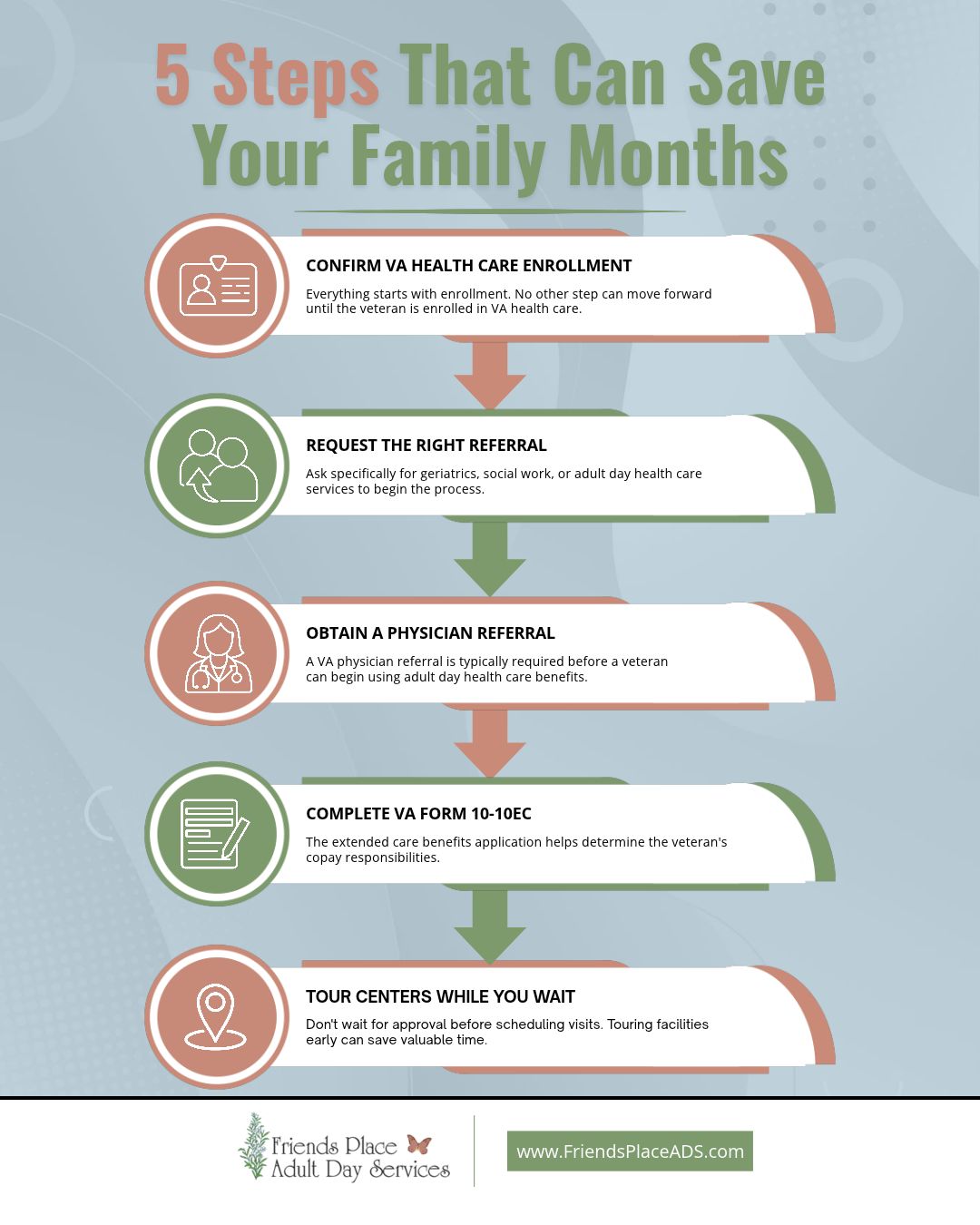
How to ask for it: five steps
Step 1: Confirm enrollment: Verify the veteran is enrolled in VA health care. If not, apply first.
Step 2: Ask for a social work consult by name: Call the veteran’s VA primary care team or the facility directly and say plainly: “I am requesting a social work consult for Geriatrics and Extended Care to evaluate my [father/husband] for Adult Day Health Care.”
Using the exact program name changes the conversation. It signals you already know the benefit exists, and it routes the request to the right service line instead of a general inquiry queue.
Step 3: Prepare for the assessment: Bring specifics, not impressions. Write down, over one week: how many times you assisted with bathing, dressing, toileting, or eating; any wandering, falls, or night waking; medications and who administers them; how many hours of supervision the veteran needs; and what your own work and health situation looks like. Clinical need is documented from concrete detail. “He’s declining” is weak. “He needs full assistance dressing, has fallen twice since March, and cannot be left alone for more than twenty minutes” is not.
Step 4: Complete VA Form 10-10EC: The social worker walks you through the Application for Extended Care Benefits. This determines the copay, if any.
Step 5: Name the center you want: If a community program is approved, ask whether you may choose a VA-contracted center. Families are often not told they have a preference to express. If you want Friends Place, say so and tell us at the same time, so our staff can coordinate with your VA case manager directly.
Where to start in North Texas
VA North Texas Health Care System serves the veterans most likely to attend our centers. Ask for Social Work Service or Geriatrics and Extended Care at:
| Facility | Address | Phone |
|---|---|---|
| Dallas VA Medical Center | 4500 South Lancaster Road, Dallas, TX 75216 | 214-742-8387 |
| Garland VA Medical Center | 2300 Marie Curie Boulevard, Garland, TX 75042 | 469-797-2100 |
| Sam Rayburn Memorial Veterans Center | 1201 East 9th Street, Bonham, TX 75418 | 903-583-2111 |
| Plano VA Clinic | Plano, TX | 972-801-4200 |
| Fort Worth VA Clinic | Fort Worth, TX | 817-730-0000 |
General VA North Texas appointments: 800-849-3597. Facility details are on the VA North Texas Health Care System website.
Veterans referred by a VA physician can attend Friends Place in Richardson or DeSoto. If you are unsure who to call first, call us; our staff has walked many families through this and can tell you exactly which office handles it.
What a covered day includes
A VA-covered day at Friends Place is the same day every other member receives. Nothing is stripped down:
- A licensed nurse on duty, with medication administration, blood pressure and weight monitoring, glucose testing, oxygen support, health and wellness program
- A continental breakfast, a hot lunch prepared on-site, and planned snacks, with menus reviewed by a licensed dietitian, nutrition and dietary services
- Twice-daily exercise, mind fitness, music, therapy dogs, and intergenerational programming recreational and therapeutic activities
- Showers, shaves, nail and foot care, and licensed salon services personal care services
- A one-to-five staff-to-member ratio, with staff certified in CPR and first aid
If you want to picture it concretely, we wrote out a full day at the program, hour by hour.
Serving North Texas Veterans Since 2014
Friends Place DeSoto received its first contract with the U.S. Department of Veterans Affairs in January 2014, so veterans referred by a VA physician could attend our specialized Alzheimer’s and dementia day program. Within months, veteran attendance grew, and one gentleman who had to leave earlier that year for financial reasons was able to come back. Today, both our Richardson and DeSoto centers hold VA contracts.
Our DeSoto center serves veterans and families from DeSoto, Cedar Hill, Duncanville, Lancaster, Grand Prairie, Red Oak, Ovilla, Midlothian, Waxahachie and all of southwest Dallas County.
How Our Program Helps Veterans
- Preserve social and language skills and cognitive abilities
- Build relationships with peers
- Stay physically active with exercise twice daily
- Minimize stress, agitation and the risk of falls
- Maintain proper nutrition and hydration
- Receive medications from a licensed nurse when needed
- Restore dignity and improve self-esteem
How Families Benefit
- Affordable care options, including VA coverage
- A reliable break from caregiving
- The opportunity to keep working
- Caregiver resources and support
- Information and referral
- Peace of mind
Our goal is the same today as it was in 2014: help veterans with Alzheimer’s and other dementias stay at home longer, delay placement in a long-term care facility, and keep the highest possible level of function and independence. Learn more on our Veterans page.
If Adult Day Health Care is not the right fit
ADHC is the most direct route to covered adult day care, but it is not the only VA support available to a caregiving family. Ask your social worker about:
- Homemaker and Home Health Aide Program: Trained aides in the home for personal care and daily activities.
- Respite Care: short-term relief so the caregiver can rest, recover, or travel; can be provided at home, in a facility, or through an adult day program.
- Veteran-Directed Care: A flexible budget the veteran manages to purchase their own services.
- Program of Comprehensive Assistance for Family Caregivers (PCAFC): A stipend, training, and health coverage for eligible primary family caregivers.
- Aid and Attendance: An increased monthly pension for wartime veterans and surviving spouses who need help with daily activities or have significant cognitive impairment. It is a separate, needs-based program with income and net worth limits, and the amounts change every December 1. Check the current rates on VA.gov rather than relying on third-party charts.
An important distinction families get wrong: Adult Day Health Care and Aid and Attendance are not the same benefit and are not applied for the same way. ADHC is a health care service arranged through the VA medical system. Aid and Attendance is a monthly pension benefit administered through the Veterans Benefits Administration. If someone told you to “apply for Aid and Attendance to pay for daycare,” that may still be worth doing, but it is a longer route, and it is not the one described on this page.
How long it takes
Timelines vary by facility, caseload, and how quickly the assessment can be scheduled. Families should generally expect weeks rather than days between the first phone call and the first covered day.
Two things shorten it: requesting the social work consult by name at the first call, and arriving at the assessment with a written, specific record of daily care needs. Two things lengthen it: waiting for someone at the VA to bring it up, and starting the process during a crisis, when everyone involved has fewer options.
Start the conversation this week
If you are caring for a veteran with Alzheimer’s, dementia, or memory changes anywhere in the Dallas–Fort Worth area, the next step costs one phone call.
Call us, and we will tell you, honestly, whether this benefit is likely to apply to your family and exactly who to call at the VA. If it turns out we are not the right center for you, we will say that too.
Schedule a tour · Richardson: (972) 437-2940 · DeSoto: (972) 274-2484 · Veterans information
Yes. Adult Day Health Care is part of the VHA Standard Medical Benefits Package. Enrolled veterans who meet the clinical need and are eligible for community care can receive it, including at community centers contracted with the VA in the Dallas–Fort Worth area. A copay may apply based on service-connected disability status and financial information.
No. Enrollment in VA health care, clinical need plus availability, is what determines eligibility. Service-connected status and finances affect whether a copay is charged.
Yes. The Richardson and DeSoto centers hold contracts with the U.S. Department of Veterans Affairs, and eligible veterans referred by a VA physician can attend. Most attend at no cost.
Either. Call VA North Texas and request a social work consult for Adult Day Health Care, or contact us and we will help you identify the right office and coordinate with your VA case manager.
The Application for Extended Care Benefits. A VA social worker or case manager completes it with you to determine your copay amount, if any.
Yes. Adult Day Health Care can be a half-day or full-day program, and veterans typically attend several days a week. At Friends Place, members may attend any five hours during operating hours with a reservation.
Adult Day Health Care is a benefit for the veteran. Surviving spouses of wartime veterans may qualify separately for Survivors Pension with Aid and Attendance, which is a different program with its own eligibility rules.