


TL;DR
You have probably already done the hard part. You looked into it, you asked around, maybe you sat in a parking lot and read reviews on your phone. Somewhere in there you decided that a day program could genuinely help. And then you ran into the last thing standing between you and that help, which is a conversation with the person it is actually about.
This guide is about that conversation. Not how to talk someone into something, because that rarely works and it rarely feels good afterward. It is about the words that make a good idea sound like what it really is: an invitation to a place where people are glad to see you.
The Sentence You May Hear First
“I don’t need that.”
If that has already happened at your house, nothing has gone wrong. You did not blow your one chance, and your loved one is not being difficult. What you ran into is the completely reasonable reaction of a person who has spent the last year or two watching things get quietly taken off their plate. The car keys. The checkbook. The stove. Then someone they love walks in and starts a sentence that sounds like it ends with one more thing being taken away.
So they close the door before you can finish. Not because they heard your idea and rejected it, but because they never got to hear the idea at all. They heard the shape of it, and the shape was familiar in a way they did not like.
That distinction matters more than almost anything else in this guide, because it means the problem is usually fixable. You are not up against a firm opinion about adult day services. You are up against a first impression that formed in about two seconds, and first impressions can always be changed.
Why “I Don’t Need That” Usually Isn’t a No
Listen closely to what people actually say when they push back. It is almost never “that place sounds bad.” It is something else entirely.
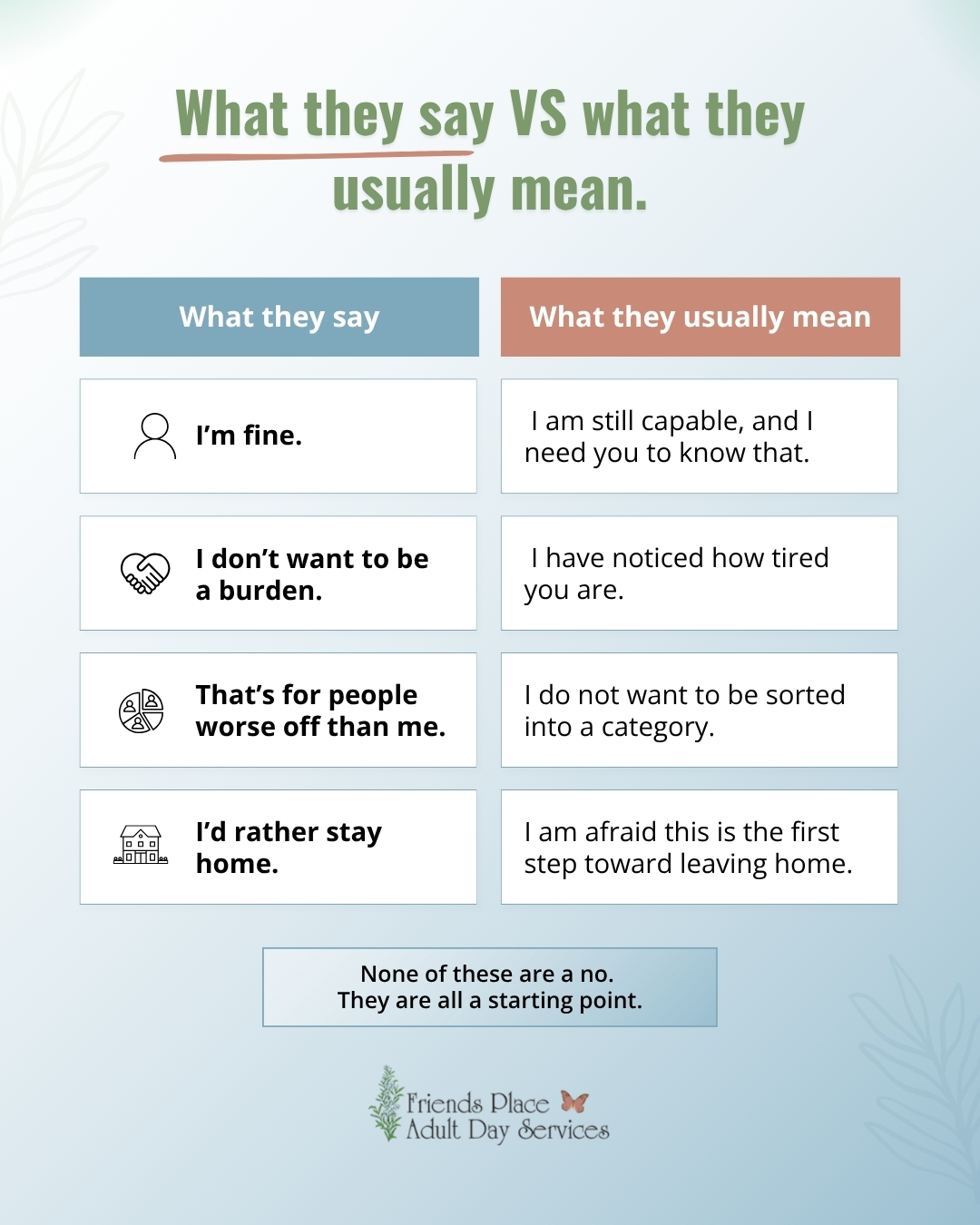
“I’m fine.” “I don’t want to be a burden.” “That’s for people who are worse off than me.” “I don’t want strangers looking after me.” “I’d rather stay home.” Every one of those is a sentence about identity, not about the program. They are all versions of the same underlying statement, which is: I am still me, and I would like to stay that way.
That is not resistance you have to overcome. That is information you can build on. Because a good day program is one of the few things in the whole landscape of care that is genuinely on the side of that sentence. Nobody moves. Nobody gives anything up. They go somewhere in the morning, they do things they are good at, and they come home to their own bed at night. The whole point is staying yourself for longer.
The trouble is that none of that comes through in the first ten seconds, and the first ten seconds are usually all you get. Which is why the words matter so much.
What Do I Even Call It?
Here is a problem nobody warns families about. The words the industry uses are almost perfectly designed to get a no.
Every word available to you sounds like a building. “Facility” sounds like a place with a front desk and a visiting policy. “Program” sounds like something a doctor put you in. “Enroll” belongs to school. “Placement” belongs to a conversation nobody wants to have. And whichever one you pick, your loved one is hearing an institution, not a Tuesday.
So listen to what families and members actually end up calling it once someone has been coming for a few weeks. They call it the center. My Tuesdays and Thursdays. My group. The place where my friends are. One daughter told us her mother started referring to it as “my club,” and that was the end of the conversation about whether she was going.
You don’t have to wait for that to happen on its own. You can start there. Try the sentence out loud both ways and hear the difference for yourself:
“I’ve been looking into enrolling you in a daytime program.”
“There’s a place over in Richardson where a group meets during the day. Music, lunch, a lot of laughing. I thought we could go look at it.”
Same place. Same schedule. Same staff. One of those sentences ends the conversation, and the other one starts it. Our name is Friends Place for a reason, and the members are the ones who taught us that the name is the easiest part to get right.
A quick note on honesty, because this is the part families worry about. You are not tricking anyone. Everything in that second sentence is true, and you are going to walk in the front door together and see it with your own eyes. You are choosing which true thing to say first. People do that for each other constantly, and it is a kindness, not a trick.
Picking the Hour, Not Only the Week
Most families put a lot of thought into what to say and almost none into when to say it. That is backwards. Timing does more work than wording does.
Memory loss tends to run on a daily arc. For a lot of people, the clearest, steadiest, most agreeable hours are mid-morning, after breakfast has settled and before the day has worn anything down. Late afternoon and early evening are usually the hardest, which is exactly when most adult children finally have a free minute to bring something up. If your only window is seven in the evening, the conversation is starting with a handicap that has nothing to do with your loved one’s opinion.
A few things that help more than they should:
Bring it up sitting side by side rather than across a table. Driving somewhere is close to ideal, because nobody has to hold eye contact and either person can let a pause sit there.
Do not open the conversation on the heels of a hard moment. If something went wrong that morning, that morning is now evidence in an argument, and your loved one will hear the whole thing as a consequence.
Keep it short the first time. Sixty seconds and then genuinely change the subject. You are planting something, not closing something.
And leave it alone for a few days. Families are often surprised when the person brings it back up themselves, usually sideways, usually while doing something else. That is what thinking about it looks like.
Words That Open the Door, and Words That Close It
After twenty years of walking families through this in Richardson, some patterns are hard to miss.
Phrases that tend to open the door
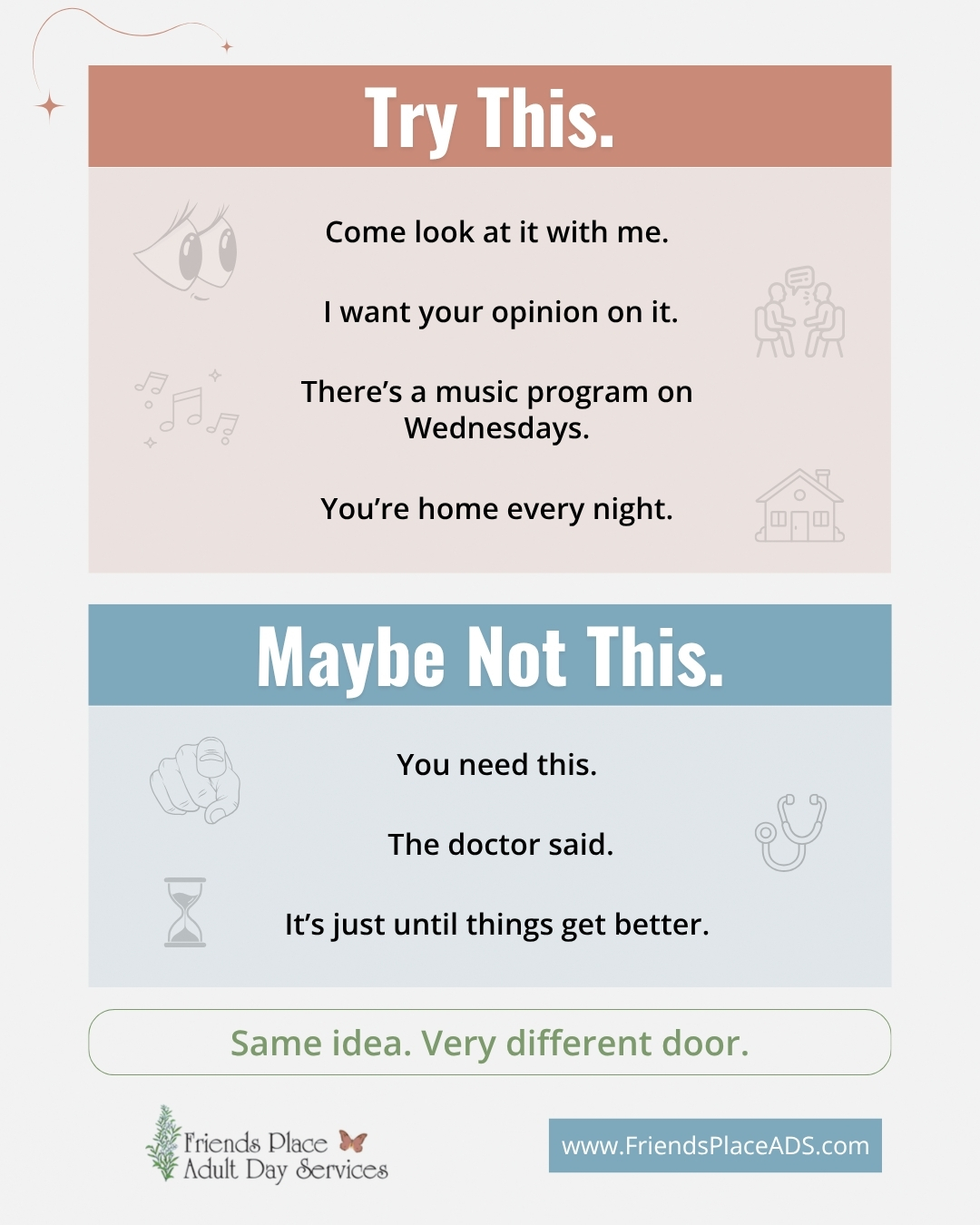
“Come look at it with me.” You are asking for company, not agreement. It is a small ask, and it puts you on the same side.
“I want your opinion on it.” This is often the single most effective sentence in the whole conversation, and it works because it is true. You genuinely do want to know whether they liked it. Being asked for your judgment is the opposite of being managed.
“There’s a music program on Wednesdays.” Specific beats general every time. A category is easy to refuse. A live band and a lunch on Wednesday is a thing a person can picture.
“Just for a few days a week, and you’re home every night.” Say the home part early. A surprising number of people are quietly braced for the other version of this conversation, and hearing that this is not that one changes everything that comes after it.
Phrases that tend to close it
“You need this.” Nobody in the history of the world has said thank you to that sentence.
“The doctor said.” True or not, this turns a family conversation into a medical order, and people push back on orders.
“It’s just until things get better.” It sets up a promise you may not be able to keep, and it plants the idea that this is a holding pattern rather than something good on its own terms.
“I can’t keep doing this.” It might be the truest thing you could say, and it is worth saying out loud to someone. Just not as the opening line of this particular conversation, because it makes the person you love into a problem being solved.
Lead With What They Get, Not What You Need
This is the pivot most families have to make, and it is uncomfortable at first because your need is real and it is right there.
You are tired. You have not had an uninterrupted workday in months. You would like to go to your own doctor’s appointment without arranging a relay. All of that is legitimate, and none of it belongs in the first conversation, because the moment you lead with what you need, a person who loves you will hear that they have become work. And then they will refuse out of pride, or agree out of guilt, and neither one of those makes for a good first week.
Lead with the day instead. The morning stretch and exercise. The trivia that somebody always wins on purpose. The dog that comes on a schedule and knows exactly whose lap is the good lap. Lunch at a table with other people at it, which for a lot of members is the part that changes things fastest, because eating alone every day at home wears on a person in a way that is hard to name.
If you want a full picture of what actually fills those hours, our recreational and therapeutic activities page walks through the music, the therapy dogs, the twice-daily exercise, and the mind fitness work that make up a normal week. It is a useful thing to scroll through together, because it turns an abstract idea into a Tuesday.
Your own relief is real, and it arrives anyway. It just does not need to be the headline.
Scripts for the Conversations Families Actually Have
Nobody wants a script until about ten seconds before they need one. Here are a few, written the way people actually talk. Change the words to sound like you.
When they insist nothing is wrong
“I know you’re managing fine. This isn’t about that. There’s a group that meets over in Richardson, and I think you’d honestly like the people. Would you come look at it with me and tell me what you think?”
When they say it is for people worse off
“That’s what I thought too before I went. It’s a mix. Some folks are further along, some are sharp as anything and just want somewhere to go. Come see who’s actually there before you decide.”
When they do not want strangers helping them
“They won’t be strangers after a week. And honestly, half of what they do is play music and run activities. Nobody’s hovering.”
When they are worried about the cost
“Let me find out the real numbers before either of us worries about it. It’s less than people expect, you pick the days, and if you’re a veteran there’s a good chance it’s covered.”
When they say they would rather stay home
“Good, because that’s the whole idea. You’d go for the day and be back in your chair by dinner. This is how people stay home longer, not the other way around.”
When they turn it around on you
“Yes, it would help me. I’m not going to pretend it wouldn’t. But I wouldn’t bring it up if I didn’t think you’d actually enjoy it, and if you hate it after a week, we stop.”
That last one deserves a note. Somewhere in here you will probably get asked point blank whether this is for you or for them. Answer honestly. Families who dodge that question tend to spend the next month relitigating it. Families who say “both, and here’s why” usually move forward.
When You’re the Spouse and Not the Adult Child
Most articles about this conversation are written for adult children, and then a wife in her eighties reads them and finds that none of it fits her house.
It is a different conversation when you have been married for fifty years. There is no authority to fall back on, and there is no going home afterward, because you are already home. You are asking someone you have shared every decision with to do something separately from you, possibly for the first time in decades. That is its own kind of hard, and it deserves its own language.
What spouses tell us works is making it mutual rather than one-directional. “I need a few hours to get the house sorted out, and I hate doing it while you’re waiting on me” is honest, and it does not put anyone in a category. So is “we’re both a little stir crazy.” So is going along on the first visit and sitting in on an activity together, which we are always happy to arrange, and which a lot of spouses find reassuring for reasons they did not expect.
One more thing, said gently. Spouses are the most likely people in the world to wait too long. You are with it every hour, so the changes are gradual, and there is no coming home from a trip and noticing. If someone in your life has said something to you about how tired you look, that is worth listening to.
Getting the Rest of the Family Saying the Same Thing
One conversation is manageable. Four different versions of one conversation, from four people who each phrased it their own way, is a lot harder on the person receiving them.
It helps enormously to agree on the language before anyone brings it up. Not a rehearsed speech, just a few settled points: what you are all going to call it, what the first ask is, and who is going to make it.
The what-to-call-it part matters most. If you are describing a group that meets during the day and your brother calls it “that facility” on speakerphone that same afternoon, you have undone a week of careful work in four seconds. Pick the words together.
The first ask should be the same from everyone, and it should be small. “Go look at it with me” is the ask. Not “go a few days a week.” Not “try it for a month.” One visit, together, no decision at the end of it.
And one person should be the one who brings it up. Usually the person who’s read on the situation the rest of you trust most, or the one your loved one has always taken advice from, which is not always the same person as the one doing the most caregiving. Everyone else supports it later, in ordinary conversation, without pressing.
If a sibling is not on board, have that out separately, on the phone, without your loved one in the room. Families who work out their disagreement privately and then arrive with one voice tend to get further than families who negotiate in front of the person they are talking about.
Making the First Visit Feel Like an Invitation
Everything up to here has been about getting through the front door. Here is how to keep the visit itself from undoing the work.
Come at a good hour. Mid-morning, when a program is at its liveliest, and there is actually something to watch. An empty room at four in the afternoon makes a poor first impression of a place that was full of music at ten.
Come to look, not to decide. Say that out loud in the car on the way. If your loved one knows nothing is being signed today, they can look around with curiosity instead of bracing. Tell us that is where you are, and we will treat the visit that way, because we would much rather someone come back a second time genuinely ready than say yes once under pressure.
Let them talk to a member, not only to us. Staff can describe a program all day. Another person their own age saying “yeah, I come Tuesdays and Thursdays, it’s good” does something a brochure cannot.
Watch what catches their eye rather than steering it. Some people light up at the music. Some head straight for the exercise. Some do not react to anything until lunch and then ask when it is served. Whatever they noticed is the thing to talk about on the drive home, and it is the thing to mention again next week.
And ask them, honestly, what they thought. Then let the answer be the answer, at least for that day. A person who feels their opinion was actually collected is far more likely to say yes the second time.
What the First Few Days Usually Sound Like
Say the visit went well and there is a first day on the calendar. Families almost always want to know what to expect, and mostly what they want to know is what to say.
That first morning, keep it light and keep it short. The single most useful sentence is a specific pickup time. “I’ll be back at four” does more good than any amount of reassurance, because it turns an open-ended situation into a defined one. Then go. Long goodbyes at the door make the morning harder for everyone, including the staff who are trying to get someone settled.
Expect the first day to be a little flat. That is normal, and it is not a verdict. A new place with new faces takes a few visits to become a place where you know people, and that is true of anyone at any age. Most families find that somewhere between the third and the sixth visit, something shifts. Someone mentions a name. Someone asks whether tomorrow is a day they go.
You may also get a rough report at pickup on a day the staff describes as a good one. Both things can be true. Memory loss makes recent hours hard to hold onto, and a person can genuinely enjoy an afternoon and not be able to give you an account of it. Ask us how the day went, and take that alongside what you are hearing at home.
And expect your own strange few days. A lot of caregivers describe the first quiet morning as unsettling rather than restful. You have been on call for so long that having nothing to do feels like something is wrong. That passes, usually around the second week, usually around the time you realize you slept properly.
When the Conversation Has to Happen More Than Once
Here is the part that catches families off guard, and almost nobody writes about it. You have the conversation. It goes beautifully. Everyone agrees. And on Thursday morning your loved one has no memory of any of it and asks where they are going.
This is not a setback, and it is not a change of mind. Memory loss does not hold onto plans well, and a decision made on Monday may simply not be available on Thursday. What usually is available is the feeling that came with it. People often keep the sense that something was agreeable long after the details are gone, which is why the tone of that first conversation matters more than its content.
A few things make the repeat versions easier. Keep the answer short and identical every time, so it becomes familiar the way a routine does. “You go on Tuesdays and Thursdays, and I pick you up at four” works better than a fresh explanation each morning, because a fresh explanation sounds like a new proposal.
Answer as though it is the first time being asked, because for the person asking, it is. Impatience is the thing that turns a simple question into a hard morning, and it is completely understandable on the fourth repetition, which is exactly why it helps to have one short sentence ready instead of improvising.
Let the day itself do the persuading. Once someone has been coming for a couple of weeks, the argument stops being verbal. The bag by the door, the day of the week, the fact that somebody there knows their name. Routine tends to settle this question long before any conversation does.
And do not take the repeated question as evidence that it is not working. Families sometimes read it that way and quietly pull back right as things were starting to take hold. Ask us how the days are actually going. That is usually a better measure than what gets remembered at breakfast.
If the Answer Is Still No for Now
Sometimes you do everything right, and the answer is still no. Here is what we would tell you if you called us about it, because people do.
First, a no today is not a no forever, and you have not wasted anything. The idea is in the house now. It is a known option rather than an ambush, and the next conversation starts from a completely different place than the first one did.
Second, do not make it a campaign. Bringing it up every few days turns a good idea into a source of friction, and it gives your loved one a position to defend. Let a couple of weeks go by. Mention it once, lightly, when something naturally connects to it.
Third, try a smaller door. A single visit with no commitment attached. A couple of hours instead of a full day. Coming along to a music program as a guest. We can accommodate all of these, and we would rather someone start small than not start.
Fourth, let someone else raise it. A physician, a friend from church, a neighbor whose wife went somewhere similar, a son who lives out of state and calls on Sundays. The same sentence lands differently depending on who says it, and there is no reason not to use that.
And call us in the meantime, even if nothing is happening yet. We talk with families who are months away from being ready, and we are glad to. There is nothing to sign and nothing to commit to. Knowing what the option looks like makes the next conversation easier to have.
How Friends Place Helps the Conversation Along
We have been doing this in Richardson since 2005, which means a lot of families have walked through our door in exactly the spot you are in.
You can bring your loved one for a visit without any commitment, and you can tell us on the phone beforehand where things stand. If the visit needs to feel like a look around rather than an evaluation, say so and we will run it that way. If your loved one responds better to talking with another member than to a tour, we will make that introduction.
You can also come by yourself first. Plenty of families do, and it is often the smartest first step, because it is much easier to describe a place you have actually stood in. You will be able to answer the questions you are about to be asked instead of guessing at them.
When someone does start, a few things about how we are set up tend to make the early weeks easier. There is supervision on site, so medications, blood pressure, glucose checks, and oxygen are handled during the day rather than becoming one more thing on your list. Meals are made here, with a continental breakfast, a hot lunch served restaurant-style, snacks, and menus reviewed by a dietitian. The activity program is built specifically for memory loss, which is different from a general senior center in ways that show up quickly. And Friends Place is licensed by the State of Texas and approved by the VA, so eligible veterans can often attend at no cost.
Barbara, whose husband attended for about a year and a half, wrote that our staff “offered groups to help us understand what our loved ones were experiencing and ways to help them through each step.” That support for the family is part of the program, not an extra. The conversation you are having right now does not have to be one you figure out alone.
What Families in Richardson Tell Us
We would rather let families speak for themselves.
Cindi wrote about her mother: “Friends Place provides excellent care for my mother. She loves going there. She receives much-needed stimulation and social interaction. The staff is wonderful, responsive, and professional. They’re empathetic, compassionate, and caring.”
Barbara wrote about her husband: “My husband was there for about a year and a half and enjoyed the activities and other clients… The staff was wonderful and supportive and offered groups to help us understand what our loved ones were experiencing… They were my angels.”
And Tara, who has performed for our members, wrote: “I have had the wonderful pleasure of singing and entertaining this wonderful group of folks at Friends Place Adult Day services in Richardson! Jane and her staff truly exhibit love and respect for all those in their care, and have created an atmosphere of community and fun.”
Notice what none of those reviews mention. Not one of them is about the conversation that got the family through the door. Six months in, that part is the least memorable thing about the whole experience. It only looms this large while you are standing in front of it.
Serving Families Across Richardson and the Surrounding Area
Our Richardson center at 1960 Nantucket Drive is open Monday through Friday, 7:30 AM to 5:30 PM, and welcomes families from across the North Dallas area.
Communities we serve from Richardson
Richardson · Garland · North Dallas · Dallas · Carrollton · Allen · McKinney · Frisco · The Colony
If you are searching for adult day services near you in the North Dallas area, or for a memory care day program that your loved one might actually enjoy, we are glad to talk through whether we are the right fit before you bring anyone in.
Whenever You’re Ready, We’re Here
The conversation is almost always harder in your head than it turns out to be. It’s worth having sooner rather than later, because the earlier someone starts, the more there is for them to enjoy and hold onto.
Come see the place first, with your loved one or without them. Walk through during a music program. Meet the people who would know their name by the end of the week. Ask us anything, including the awkward questions, because we have heard all of them and we would rather you ask.
Schedule a visit: friendsplaceads.com/schedule-a-tour
Call us: Richardson and Plano (972) 437-2940 | DeSoto (972) 274-2484
Start smaller than you think you need to. Ask them to come look at a place with you and give you their opinion, rather than asking them to attend. Describe the day itself, the music, the lunch, the people, rather than the category it belongs to. And say early that they come home every evening, because that is often the thing they are quietly worried about.
That is the most common first response there is, and it usually means they do not want to be sorted into a group of people who need things. It is rarely an opinion about the program itself, which they have not seen yet. Leave it a few days, then ask them to come look at it with you rather than asking them to go.
Either works, and going by yourself first is often easier. It lets you answer their questions from experience rather than from a website, and you will have a much better sense of whether the timing is right. You are welcome to visit our Richardson center on your own and bring them back later.
Give a specific pickup time, say something ordinary and warm, and then go. “I’ll be back at four” is the most useful sentence you can offer. Drawn-out goodbyes make the morning harder for everyone, and people settle in faster once the room is theirs for a while.
Our program is built for adults 50 and older living with a dementia diagnosis who can move about independently or with a mobility aid and can benefit from the activities we offer. If you are not sure where your loved one falls, call us and describe the situation. We will tell you honestly whether we are a good fit.
Cost depends on the days and hours you choose, and families are often surprised how much more affordable it is than they expected. Long-term care insurance is accepted, and Friends Place is approved by the VA, so eligible veterans can often attend at no cost. Call our Richardson center, and we will walk you through the real numbers for your schedule.
Then you stop, and you have lost nothing but a few days. Say that out loud when you first bring it up, because it takes the weight off the decision. It usually takes three to six visits before a new place starts to feel familiar, so it is worth giving it a little runway before deciding it did not take.