


You have probably been told that an adult day program would help. What nobody tells you is what actually happens between drop-off and pickup, and that is exactly the part you need to know before you can picture your mother, your husband, or your father there.
So here is the whole day. Not a brochure version. The real rhythm of a day at Friends Place Adult Day Services, a dementia day program serving Richardson, DeSoto, and Plano, Texas, from the first ten minutes to the last goodbye at the door.
The short answer
A dementia day program runs like a well-paced school day for adults. Members arrive in the morning, share breakfast, move through a structured cycle of exercise, cognitive activities, music, and social time, eat a hot lunch, rest in the early afternoon, then wind down before pickup. A licensed nurse is on-site the entire time. At Friends Place, the day runs Monday through Friday, and families may choose a half day (five hours or less) or a full day.
The purpose behind that structure is not to keep people busy. It is to give someone with Alzheimer’s or dementia a day they can succeed at, predictable, unhurried, and free of the small failures that pile up at home.
7:30 – 8:30 a.m. Arrival and the first ten minutes
The doors open at 7:30 a.m. in Richardson and 8:00 a.m. in DeSoto and Plano. Most families arrive in this window on their way to work.
The first ten minutes matter more than any other part of the day, so they are handled deliberately. A staff member meets each member at the door by name. There is no sign-in clipboard shoved at anyone, no waiting in a lobby. Coats go away, and the member is walked straight to a table where familiar faces are already sitting with coffee.
For families, this is the moment that feels hardest the first week. It gets easier faster than you expect, usually because the person you dropped off has already turned toward someone else by the time you reach your car.
Meanwhile, the nurse is quietly doing a visual check on everyone who walks in: gait, color, mood, whether the swelling in someone’s ankles looks different from Friday. Nothing about it feels clinical. It is a greeting that happens to be an assessment.
8:30 – 9:00 a.m. Breakfast and settling in
A continental breakfast is served with coffee, juice, and water. Every meal and snack at Friends Place is prepared fresh on-site, and the menus are reviewed by a licensed dietitian.
Breakfast is not just food. It is the transition, the buffer between the car ride and the day. People catch up. Staff learn who slept badly, who is having a stiff morning, who needs today taken a little slower. That information shapes the next eight hours.
Hydration starts here and continues all day; juice and water are offered at least three times daily, because dehydration is one of the most common and most preventable causes of sudden confusion in older adults with dementia.
9:00 – 9:45 a.m. Morning exercise
Seated and standing exercise, adapted so that everyone in the room can participate at their own level. Stretching, range of motion, light resistance, balance work, and a good deal of laughing.
Movement early in the day is deliberate. It helps regulate sleep at night, reduces afternoon restlessness, and supports the mobility that keeps someone safely at home. Exercise happens twice a day at Friends Place for exactly this reason.
9:45 – 10:30 a.m. Mind fitness
Trivia, word games, reminiscence, current events, and structured cognitive activities are what the team calls mind fitness.
The skill here is invisible. Activities are pitched so that participation is easy and success is likely. Questions are open enough that there is no wrong answer to be embarrassed by. Someone in early stage and someone in mid stage can sit at the same table, and both walk away feeling capable. That is a very different experience from a family quiz at the kitchen table, where every forgotten answer lands like a verdict.
You can see the full range of recreational and therapeutic activities offered across the week.
10:30 – 11:30 a.m. Personal care and salon services
This runs in rotation alongside the group activity, not instead of it. Over the course of a week, members may receive a shower, a shave, hair shampoo and blow-dry, nail care with a hand and arm massage, or foot care with a leg massage. Licensed salon services are available for both men and women.
For a caregiver, this hour is often the one that changes everything. Bathing and grooming are the two tasks that turn adult children into adversaries and spouses into nurses. Handing them to trained staff, in a setting where the person being cared for feels pampered rather than managed, quietly gives you your relationship back. Personal care services cover what is included.
11:30 a.m. – 12:00 p.m. Music
A daily sing-along, live entertainment, or a musical program. Music is on the schedule every single day, and it is not filler.
Musical memory is among the last capacities dementia takes. People who have not spoken a full sentence in weeks sing every word of a hymn or a big-band standard. Families who visit during a music hour tend to leave with a completely different picture of what their loved one is still capable of.
12:00 – 1:00 p.m. Lunch, served restaurant-style
A hot, full lunch, served at the table rather than on a tray line. Special diets, food restrictions, and individual preferences are accommodated, and staff provides prompts, cues, adaptive equipment, and hands-on assistance as needed. Members with choking precautions are supervised throughout.
Restaurant-style service is a clinical choice as much as a hospitality one. Being served at a table with people you know preserves the dignity of a meal, and people who feel dignified eat more. Weight loss is a real risk in dementia, and lunch is where it gets addressed.
1:00 – 1:45 p.m. Quiet time
Rest, low lighting, soft music, one-to-one conversation, or simply sitting. Some members nap. Some read. Some talk to a staff member about a marriage that ended forty years ago.
This block exists because sundowning is real. Late-day agitation is often the product of an over-stimulated afternoon, and a planned rest before 2:00 p.m. does more to prevent a difficult evening at home than anything a caregiver can do at 6:00 p.m.
1:45 – 2:45 p.m. The afternoon activity
This is the part of the day that changes most: therapy dogs, arts and crafts, an intergenerational visit from local students, a themed party, gardening, or a group project.
Variety in the afternoon does the emotional work of the day. It is where members laugh out loud, where a retired teacher ends up leading a table, where a man who has not held a paintbrush in sixty years finds out he still can.
2:45 – 3:15 p.m. Snack and hydration
A planned afternoon snack with juice and water. Blood sugar and hydration both dip in this window, and both show up as confusion, irritability, or fatigue if they are not managed. Members with diabetes have glucose checked as ordered.
3:15 – 4:15 p.m. Second exercise, sing-along, outdoor time
The day’s second movement block, weather permitting, outdoors. Lighter than the morning: walking, ball toss, seated dance, a final sing-along.
Late-day light exposure and gentle movement support the body clock, which is one of the most disrupted systems in dementia. Families frequently report better nights within the first two or three weeks of regular attendance; this hour is a large part of why.
4:15 – 5:30 p.m. Wind-down and pickup
Activity slows. Belongings are gathered, personal items checked, and each member is walked to the door.
Pickup is also a handoff. Staff tells you how the day went, what was eaten, how much fluid was taken, whether medication was given, whether the nurse noticed anything. Richardson closes at 5:30 p.m.; DeSoto and Plano close at 5:00 p.m. Exact hours and daily rates are listed on the Richardson days, hours and costs page and the DeSoto days, hours and costs page, and all three centers are shown on our locations page.
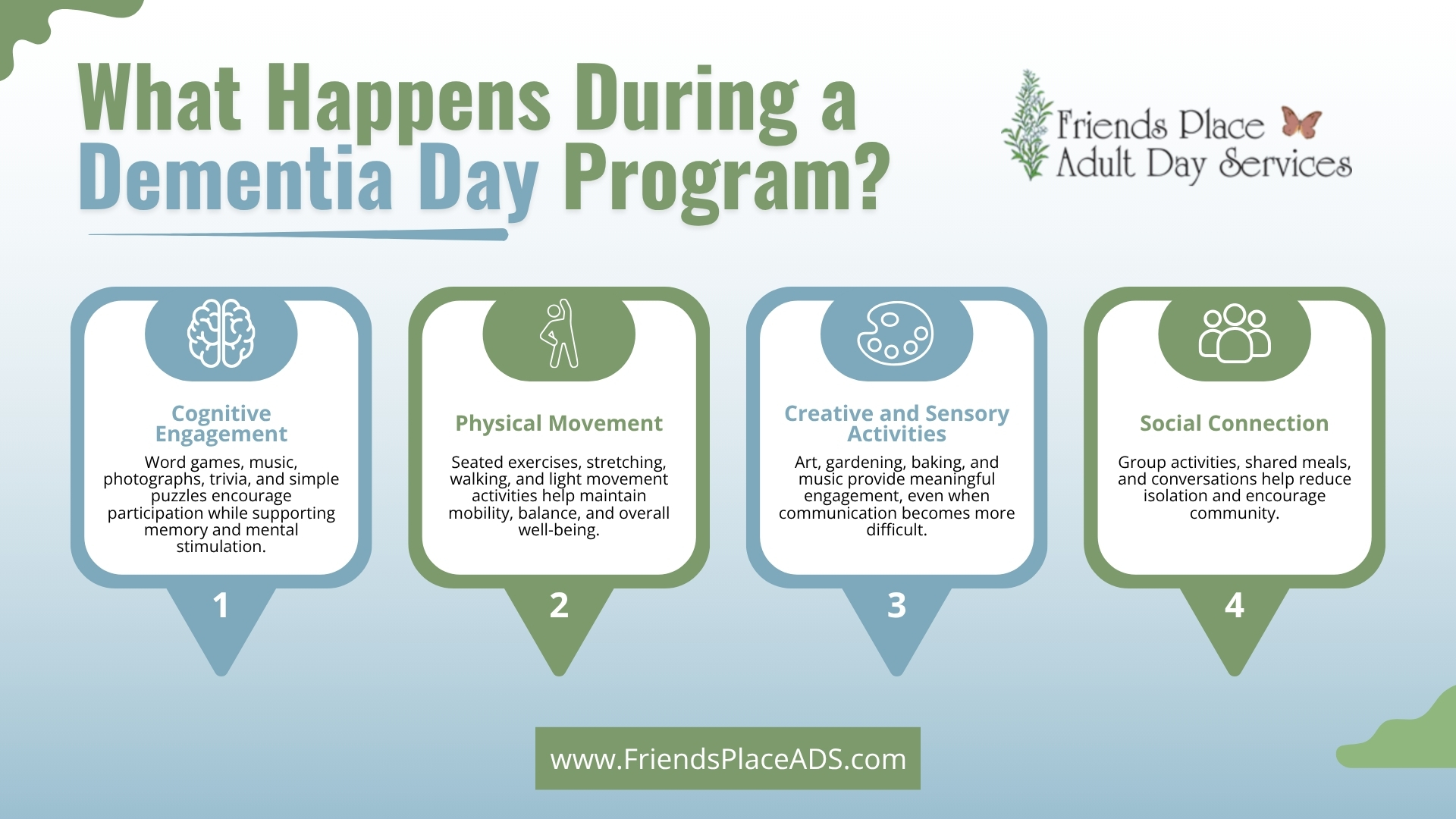
What the nurse is doing all day
A licensed nurse is on duty every day at every location. Across those eight hours, the nurse is:
- Administering or reminding on medications
- Monitoring blood pressure, weight, and glucose
- Assisting with and monitoring oxygen
- Providing ordered medical treatments
- Managing toileting reminders and incontinence care
- Assisting with transfers and ambulation
- Watching for the early signals families miss at home: a urinary tract infection presenting as new confusion, a medication side effect, a small decline in gait
Staff work at a one-to-five ratio, are certified in CPR and first aid, and complete at least twelve hours of ongoing training every year. Details are on the Health, Care and Wellness page.
That daily clinical observation is one of the least-discussed benefits of a dementia day program. Problems get caught on a Tuesday instead of in an emergency room on a Saturday.
What your day looks like
Eight hours. That is the real product.
Eight hours to work, to sleep, to sit in a doctor’s office for yourself, to see a friend, to handle the paperwork that has been stacking up, or to do absolutely nothing without listening for the back door.
Caregiver exhaustion is not a character flaw, and it is not solved by trying harder. It is solved by hours. If you are somewhere in the middle of that, our guide to dementia care at home covers the practical side of the other sixteen hours.
What the first day actually feels like
Most families expect a refusal. “He’ll never go.” “She’ll be furious with me.”
Here is what typically happens instead. The first day is short and observed closely. Staff builds the day around what that specific person responds to: music, a task, a job to do, another person to talk to. Resistance most often comes from the framing at home, not the program itself. “You’re going to daycare” lands badly. “I’m meeting a friend for lunch there; come with me” does not.
By the second week, most members are ready before their ride is. Some become the person who greets everyone else at the door.
Half day or full day
Members may attend any five hours during operating hours with a reservation. A half day is five hours or less; a full day is anything longer.
Reservations are required not to be difficult, but because meals, staffing, and the one-to-five ratio are planned around who is coming. Same-day reservations can usually be accommodated. Drop-in is not available.
Who this is for
The program is designed primarily for adults with Alzheimer’s, dementia, or memory changes, but a formal diagnosis is not required. Members living with Parkinson’s, mild cognitive impairment, stroke recovery, or general age-related decline also benefit from the cognitive and physical wellness programming. You can browse the full week of activities and the benefits of adult day services if you want more detail.
Veterans should know that Friends Place holds a contract with the VA North Texas Health Care System, and eligible veterans may attend at no cost. See the Veterans page for details, or read our full guide to whether the VA pays for adult day care.
If you are still deciding whether any of this applies to your family yet, the earlier you start, the more we can do. Reading earlier consistently produces better outcomes than waiting for a crisis.
Come see a day for yourself
Reading about a day is useful. Standing in the middle of one is better: the noise level, the smell of lunch, the way staff speak to members, how members speak to each other. Fifteen minutes in the room will tell you more than any page on this website.
Tours are welcome any weekday, and you are encouraged to come during an activity rather than a quiet hour.
Schedule a tour · Richardson: (972) 437-2940 · DeSoto: (972) 274-2484 · Plano: (972) 437-2940
Arrival and breakfast, morning exercise, cognitive and mind-fitness activities, personal care and salon services in rotation, music, a hot lunch, a quiet rest period, an afternoon activity such as therapy dogs or crafts, a snack, a second lighter exercise session, and a wind-down before pickup. A licensed nurse is on-site throughout.
Any five hours during operating hours with a reservation. Richardson is open Monday through Friday, 7:30 a.m. to 5:30 p.m. DeSoto and Plano are open Monday through Friday, 8:00 a.m. to 5:00 p.m.
Yes. A light breakfast, a full hot lunch, and planned snacks are all included and prepared fresh on-site. Menus are reviewed by a licensed dietitian, and special diets and preferences are accommodated.
No. Programs are designed primarily for people with memory problems, but a formal diagnosis is not required.
Transportation is not provided by most adult day centers, including Friends Place, but it can often be arranged through DART Paratransit or private senior transportation services. Staff can point you to options in your community.
This is common in the first week, and it usually resolves. How the day is introduced at home matters more than the program itself, and staff will help you find language that works for your family. Most members settle in within one to two weeks.
Call to arrange a tour, complete an enrollment application, bring your loved one for a short second visit and brief assessment, then set a start date and reserve days for the month. More answers are on our FAQ page.