

A Note for the Family Reading This
If you found your way here, you’re already doing something loving: looking for the best way to care for someone who matters to you. Most families reach out to us at the point where the days have gotten hard, and we understand why. But the honest answer to the question we hear most, which is when should we start, is almost always earlier than you think.
Friends Place opened in Richardson in 2005 for people in the early and mid stages of Alzheimer’s, so they could socialize with peers, keep their minds and bodies active, and stay in their own homes longer. That is still exactly who we are built for. This guide is about what early support looks like, what it gives your loved one, and why the timing matters more than most families are told.
Why Friends Place Was Built for the Early Stages
Pam Kovacs Johnson opened Friends Place in Richardson in 2005, after more than thirty years working in the field of aging. She built it for a specific person: someone in the early or mid stage of Alzheimer’s who was still very much themselves, still able to laugh at a joke and hold up their end of a conversation, and who was slowly losing the reasons to leave the house. Not someone in crisis. Someone whose world was quietly getting smaller.
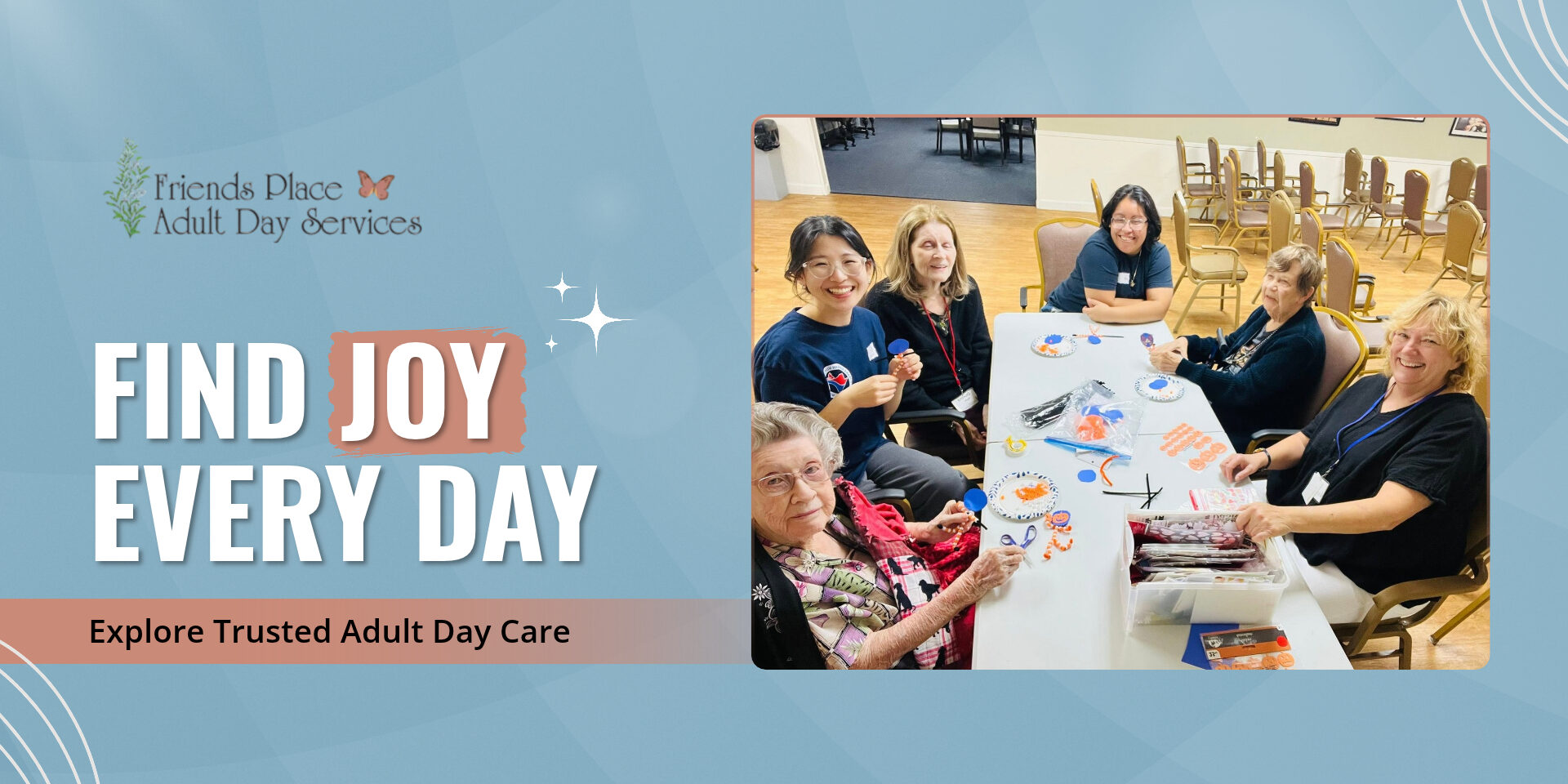
That is still who we are built for. The program gives people something to do, somewhere to be, and people to be with, at the stage when they can get the most out of all three. Members join us for the day, take part in exercise, music, games, and conversation, eat a hot lunch at a real table with friends, and go home in the evening.
A formal dementia diagnosis is not required to attend. Adults with mild cognitive impairment, Parkinson’s, and other memory changes take part in the same cognitive and physical wellness programs. If you are wondering whether it is too early, that is usually the right moment to call.
The Early Signs Worth Paying Attention To
The signs that early support would help are quieter than the ones that eventually force a family’s hand. They are easy to live alongside for a year without ever naming. Seeing them written down sometimes helps you trust what you have already been noticing.
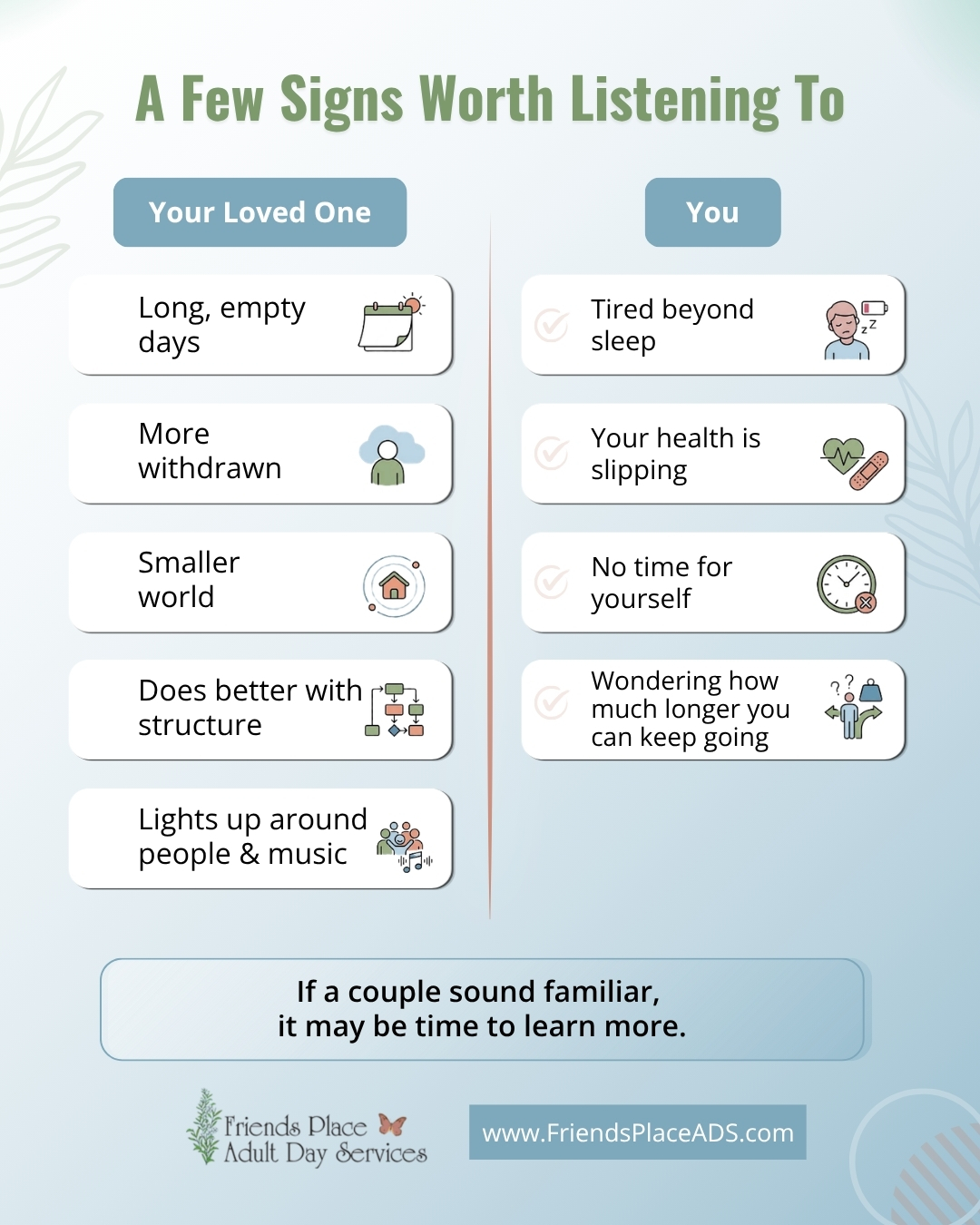
The days at home have gotten long. Your loved one is spending more hours in the same chair, with the television on, than they used to. Their circle has thinned out, and there are fewer reasons to get dressed and go somewhere. They do noticeably better with company and a plan than with an open, empty afternoon. And they still light up around music or other people, on the rare occasions those come along.
None of that is a crisis. That is the point. Every one of those is something a day program answers well, and answers better the sooner it starts.
What Early Support Gives You as a Caregiver
Your well-being is the foundation this whole arrangement rests on. Caregiving is a long road, and the families who manage it best are usually the ones who built in support before they were running on empty.
Starting early means you get regular hours back while you still have the energy to use them well. Time to work, to see your own doctor, to sleep, to be someone’s spouse or child again rather than only their caregiver. It also means the routine is already in place if things change later, and you are not trying to arrange care during a difficult week.
Waiting until you are exhausted works too. It is simply harder on everyone, and it asks your loved one to adjust to something new at the moment they have the least flexibility to do it.
When the Whole Family Isn’t on the Same Page
Deciding to bring in help is rarely one person’s decision. Siblings weigh in, sometimes from a distance, sometimes with strong feelings, and with very different levels of day-to-day involvement. One adult child sees how much the primary caregiver is handling, while another feels sure Mom is fine. A spouse may feel that accepting help changes a promise made long ago. These differences are normal. Families who love someone do not always agree at first about how to care for them.
A few things tend to help. The person handling the day-to-day usually has the clearest view of what is actually happening, and what they are carrying deserves real weight in the conversation. It also helps to talk about a day program as something added while things are still going reasonably well, rather than a response to something going wrong. That framing lands differently with a hesitant relative. And our team is glad to answer questions for a doubtful sibling or spouse directly, gently, and without pressure.
If your family is not fully aligned yet, that is okay. You do not need everyone’s agreement to start learning about your options. Information often does more to put a worried relative at ease than any argument could.
For the Working or Long-Distance Caregiver
Not every caregiver is at home full-time. Many are balancing a job with a parent’s care, fitting appointments around work and thinking about home during the day. Others live an hour or several states away, coordinating care by phone and wishing they could be closer. Both situations come with their own challenges, and both are common.
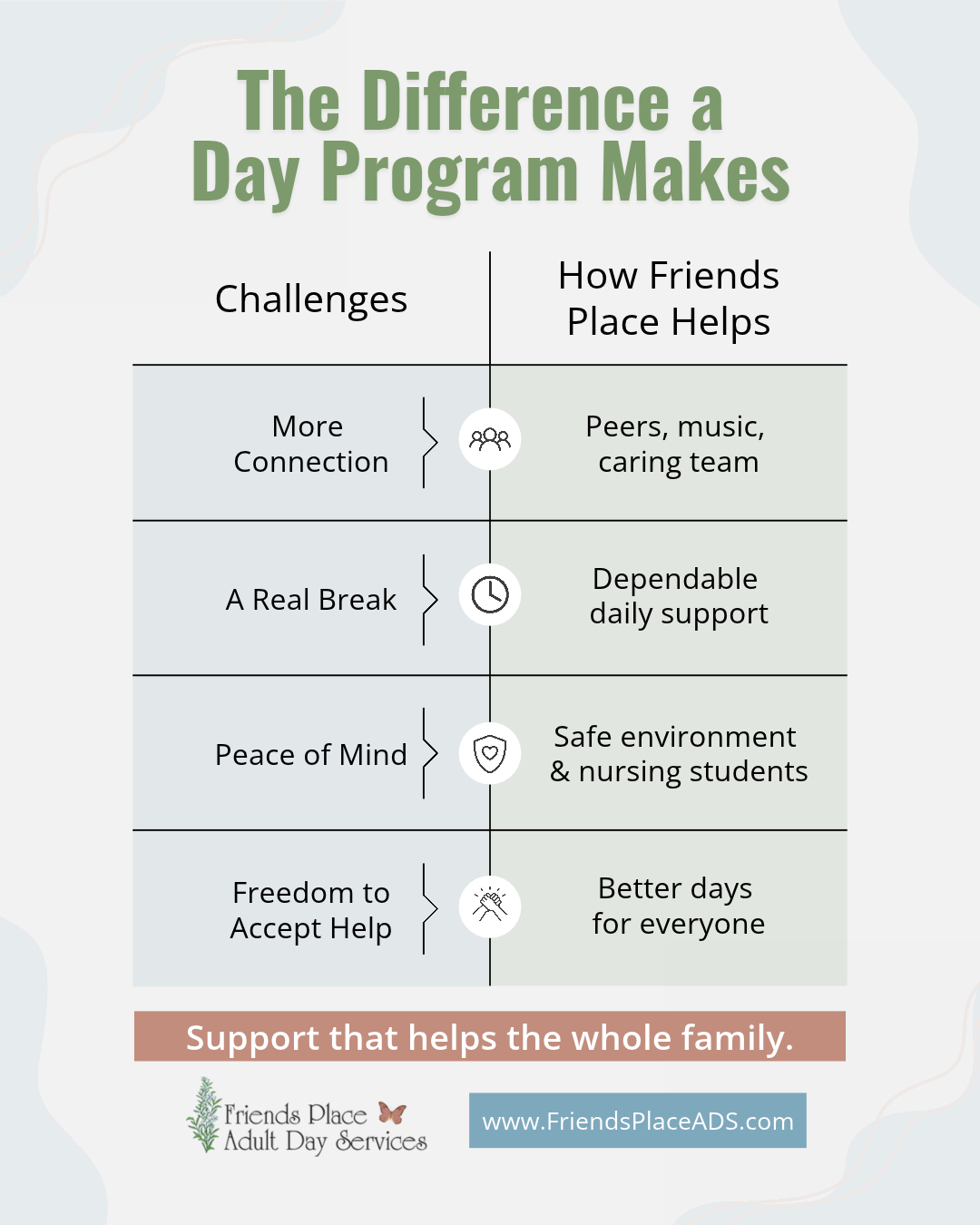
A structured daytime program anchors both. For the working caregiver, dependable hours mean you keep your job and your income while your loved one is safe and engaged during the day. For the long-distance family, knowing a parent spends weekdays somewhere warm and welcoming, with university nursing students keeping an eye on their health, brings real peace of mind. Staff who see your loved one regularly become another set of caring eyes, ready to notice a change and keep the family in the loop.
Setting this up before it is urgent is what makes it work. A program you already know, with staff who already know your loved one, is a very different thing to lean on than a program you are finding in a hurry.
How Friends Place Richardson Supports Your Family
Friends Place Adult Day Services is a specialized daytime care center for adults living with Alzheimer’s, dementia, and other memory-related conditions. Our Richardson center at 1960 Nantucket Drive has been here since 2005, and it is where the whole thing started. Two decades later, one thing has stayed the same. We see ourselves as a partner to your family, not a place where you simply drop someone off.
What that means in practice is that you stop carrying it alone. Your loved one spends the day in a space built specifically for memory care, with university nursing students on staff to monitor health and manage medications, dementia-trained team members, and a 1:5 staff-to-member ratio so there is real attention throughout the day. Richardson is open Monday through Friday, 7:30 AM to 5:30 PM.
We are also here before you ever enroll. Call with a question, and you will get an answer. If we do not think your loved one is ready, we will tell you plainly and point you toward other resources. That has been true since the first year.
What Early Support Does, Day After Day
The case for starting early is not abstract. It comes down to what a structured day actually does for a person, repeated week after week, at a stage when they can still take full part in it.
Engagement and activity
There is a schedule, and your loved one is in it. Exercise runs twice a day. There is a daily sing-along, word and trivia games, arts and crafts, live entertainment, therapy dog visits, and a participant volunteer program that gives members something real to contribute. Someone who has been spending afternoons alone in a quiet house is suddenly booked.
Social connection
Memory loss narrows a person’s world, and it narrows the caregiver’s along with it. Here, your loved one is surrounded by peers and by staff who know their name and their story. Friendships form. Members who arrive in the early stages have the easiest time forming them, which is one more argument for coming in sooner.
Cognitive, physical, and social well-being, supported together
The program is built to support all three at once because they do not come apart in real life. Mind fitness activities and games work on one side. Twice-daily exercise, meals prepared on-site and reviewed by a licensed dietitian, and health monitoring by nursing staff work another. The company and the conversation work the third. A person who is active, fed well, watched over, and among friends generally has better days than a person who is alone with the television.
A steadier rhythm at home
Families notice the evenings change first. A husband who had gone quiet starts humming on the drive home. Someone who used to drift through the afternoon comes home tired in the ordinary way, having done things. And the caregiver gets a real, dependable break instead of a promised one.
What a Good Day Looks Like at Friends Place
It is easier to feel the value of a day here than to summarize it, so here is the actual day. Members arrive to a warm welcome and a light breakfast, with health monitoring folded gently into the morning. The hours that follow hold word and trivia games, the daily sing-along and live music that reach past memory loss to something joyful, exercise twice a day, and a hot lunch prepared on-site and served restaurant-style. Afternoons bring arts and crafts, therapy dog visits, intergenerational programs, and personal care when it is needed, down to a shave or a salon appointment.
Families tell us the change shows up in small, specific ways. A mother who resisted the idea for weeks starts asking on Sunday whether tomorrow is a Friends Place day. A daughter finally sleeps through a night because she is not braced for the next thing. None of it is dramatic. It is just life getting a little steadier for everyone in the house.
What the day gives back is the point. Your loved one trades long, empty hours for friendship, activity, and dignity, and families often notice better moods and easier evenings. You get back real, reliable time. Everyone comes home in the evening, and the home life you have built together stays right where it is.
Staying Home Longer, and Why Timing Matters
For a lot of families, the fear underneath everything is that the next step has to be assisted living or a memory care facility. It does not, at least not yet. Residential placement is the right choice when someone can no longer be safe at home, even with support. But for adults in the early and mid stages of memory loss, moving too soon can be disorienting, and it removes the home and routines that many people with dementia lean on for comfort.
Adult day services offer a different path, and it is the path we were built for. Your loved one stays in the home they know, keeps the routines that ground them, and still gets professional care and real engagement during the day. By offering both a social and a medical model of care, we help members remain at home, maintain an optimal level of functioning, and delay the need for placement in a long-term care facility. Families often find that starting earlier is what buys that time.
Setting a Few Common Worries at Ease
A lot of hesitation comes from ideas that simply are not accurate, and they keep good families waiting for no reason.
An adult activity center is not a nursing home. It is not residential at all. Your loved one spends part or all of the day in a warm, engaging place and comes home to you every evening, so the home life you have built together stays intact. It is not only for the late stages, either. The early and mid stages are exactly when structure, connection, and engagement do the most good, and coming in earlier tends to make settling in easier. And it is not out of reach financially. Adult day services are among the more affordable forms of care, with long-term care insurance accepted and eligible veterans often attending at no cost through the VA.
The last worry is the quietest one. That deciding now means giving up on keeping your loved one home. It is usually the reverse. Daytime support is often the very thing that makes staying home sustainable and that holds off a bigger move.
Costs, Scheduling, and VA Benefits, Made Simple
Money and logistics are where families want plain, direct answers, so here they are without any fine print. Friends Place is $80 for a half day, defined as five hours or less, and $100 for a full day, which is anything over five hours. There is a one-time $65 enrollment fee. That daily rate covers the full program: activities, meals and snacks, health monitoring, and personal care support through the day.
To make it concrete, a family whose loved one comes three full days a week is looking at roughly $1,200 a month, and five full days land near $2,000. Compare that to assisted living or memory care in the DFW area, which commonly runs several thousand dollars a month, and to in-home care, which is often billed by the hour and adds up quickly across a full day. Two or three days a week is a common way to start, and for many families, that math is what makes keeping a loved one home both possible and sustainable.
Scheduling is flexible. You choose the days that fit your family, and members can attend for any five-hour period during operating hours with a reservation. Long-term care insurance is accepted, and our Richardson center holds a contract with the VA North Texas Health Care System through the VA Community Adult Day Health Care Program, so eligible veterans can often attend at no cost. The team is glad to help you work through what applies to your situation.
What Richardson Families Tell Us
Sometimes the most reassuring thing is simply to hear from families who were once standing where you are now. These are real words from people who trusted us with the person they love most.
One family shared, in a Google review, “I think they are angels in disguise. So very warm and welcoming. Great activities.” Another wrote, “Friends Place can bring out the best in them. This place has been a blessing for our family.” A wife named Joanna put it simply: “My husband looks forward to it. It seems to be working out better than I could have ever imagined.” And a daughter named Crystal said, “Staff is exceptionally caring and professional. My mother has been going here for years. Would not have her go anywhere else.”
Two decades in Richardson and a 4.9-star Google rating later, that trust is the thing we are proudest of. It is also why so many families tell us the same quiet thing after a while. Their loved one is happy, and they themselves can finally exhale.
Serving Families Across the DFW Area
Our Richardson center is at 1960 Nantucket Drive, and it serves families across North Dallas and the surrounding communities. If you are driving in from a nearby suburb, most families find the trip easier than they expected, and we are glad to talk through what a workable schedule looks like from where you live.
Serving: Richardson, Dallas, Garland, Plano, Allen, McKinney, Frisco, The Colony, Mesquite, and the surrounding DFW area.
The Earlier You Start, the More We Can Do
If anything in this guide matches where your family is right now, take that as a gentle nudge rather than a push. You do not have to have it all figured out, and you do not have to be sure. You can reach out simply because you want to understand what this is and whether it might help.
The earlier you start, the more we can do to help. More good days for your loved one, more room for you, and more time in the home they know. Come see it for yourself.
Schedule a visit: friendsplaceads.com/schedule-a-tour
Call us: Richardson and Plano (972) 437-2940 | DeSoto (972) 274-2484
Earlier than most families do. The program is designed for people in the early and mid stages, and that is when someone gets the most out of it. They settle in faster, take part more fully, and make friends more easily. If you are asking the question at all, it is a reasonable time to call and learn more. There is no commitment in a conversation, and it often brings real relief just to talk it through.
No. The program is designed primarily for adults with memory problems, but a formal diagnosis is not required. Adults with Parkinson’s, mild cognitive impairment, and other older adults also benefit from the cognitive and physical wellness activities. If you are unsure whether it is a fit, our team is glad to talk it through with you.
Friends Place is purpose-built for memory care rather than a general mix of needs. That means dementia-trained staff, a calm and predictable environment, activities calibrated to different stages, university nursing students on staff for health monitoring and medications, and a 1:5 staff-to-member ratio. For someone living with Alzheimer’s or dementia, the right environment can make the difference between feeling out of place and feeling like they belong.
That is exactly when the program does the most. Someone who is still conversational and mobile can take full part in the exercise, the games, the music, and the friendships, and those are the things that support cognitive, physical, and social well-being over time. Waiting until things are harder means asking them to adapt to something new with less to draw on.
Reluctance at first is common, and it usually softens. The familiar staff, the routine, the music and activities, and the sense of belonging create a day most members warm to. Many families tell us their loved one went from unsure to looking forward to it, and some ask on the weekend when they get to go back. Members who start earlier tend to make that turn faster.
Gently, and knowing that it is a common and caring feeling. Feeling protective is a sign of how much you love them, not a verdict on your worth as a daughter, son, or spouse. Accepting support is not stepping away from your loved one. Very often it is what lets you keep showing up for them with patience and warmth.
That is common, and you do not need everyone’s agreement to start learning about your options. The person carrying the daily load usually has the clearest view of what is really happening. It often helps to frame a day program as something added while things are going reasonably well, and to let our team answer questions for a hesitant relative directly. Information tends to settle worry better than any argument.
Friends Place is $80 for a half day (five hours or less) and $100 for a full day (over five hours), with a one-time $65 enrollment fee. Long-term care insurance is accepted, and for eligible veterans, VA benefits may cover the full cost. Many families begin with two or three days a week, which keeps it a far more affordable option than full-time assisted living or memory care.
Yes. Our Richardson center is contracted with the VA North Texas Health Care System through the VA Community Adult Day Health Care Program. Eligible veterans can often attend at no cost, though a small copay applies in some cases. Our team can help you determine eligibility.
It starts with a tour, with no obligation. If it feels right, you complete an application, then come back for a second, shorter visit and bring your loved one along for a brief assessment. From there, we set a start date and reserve days for the rest of the month. Call Richardson at (972) 437-2940, or schedule a tour at friendsplaceads.com/schedule-a-tour.