

Adult day care vs memory care is a licensing question in Texas before it is anything else. A day program is licensed under Chapter 103 of the Human Resources Code and, by that law’s own definition, keeps nobody overnight. Residential memory care, as Chapter 247 of the Health and Safety Code uses the phrase, is offered by a licensed assisted living facility, where a person lives. The state lists the two separately, and you can check which one any provider holds.
TL;DR
Texas issues no license called memory care. Adult day services are licensed as day activity and health services facilities under Human Resources Code Chapter 103, which defines them as serving people “on a daily or regular basis but not overnight.” Residential memory care in assisted living falls under Health and Safety Code Chapter 247, and Section 247.029 of that chapter sets up a separate classification for a facility that advertises Alzheimer’s care. Nursing facilities that offer it sit under a third chapter, 242. The Texas Health and Human Services Commission lists all three in one public search, where every provider shows a program type, a service type, and a license status. Reading that record takes a few minutes, and it tells a family in Dallas, Plano, or Garland which kind of provider they are about to tour.
Why Does a Search for Memory Care Show Places People Move Into?
Because “memory care” is a description, and the Texas chapters covered here use it only for residential licenses. The state’s long-term care provider search has no program type by that name. Its menu offers assisted living facilities, day activity and health services, nursing facilities, and a handful of others, and its help page says you can search for only one type at a time.
So the first thing the state asks is the thing most families have not been told: which kind of license are you looking for?
We see the confusion in the phrases people type before they reach our website. “Daytime assisted living.” “Memory care day center.” “24 hour memory care.” Each one is a sensible guess at a system nobody explained.
The numbers lean one way, too. Here are the total records that the state search returned on October 12, 2026 for six cities on our service-area list, searched once for each license type.
| City searched | Day activity and health services records | Assisted living facility records |
|---|---|---|
| Dallas | 11 | 105 |
| Plano | 3 | 44 |
| Garland | 5 | 23 |
| Mesquite | 1 | 13 |
| Duncanville | 0 | 3 |
| Frisco | 1 | 21 |
That is 21-day records against 209 residential ones, close to ten to one. The totals count every record the search returned, whatever its status, so they are a picture of what a family scrolls through and not a count of open programs.
Two Chapters of Texas Law, Side by Side
Everything in this table comes from the statutes themselves or from the Health and Human Services Commission (HHSC) pages for each provider type. Where the wording is the state’s, it sits in quotation marks.
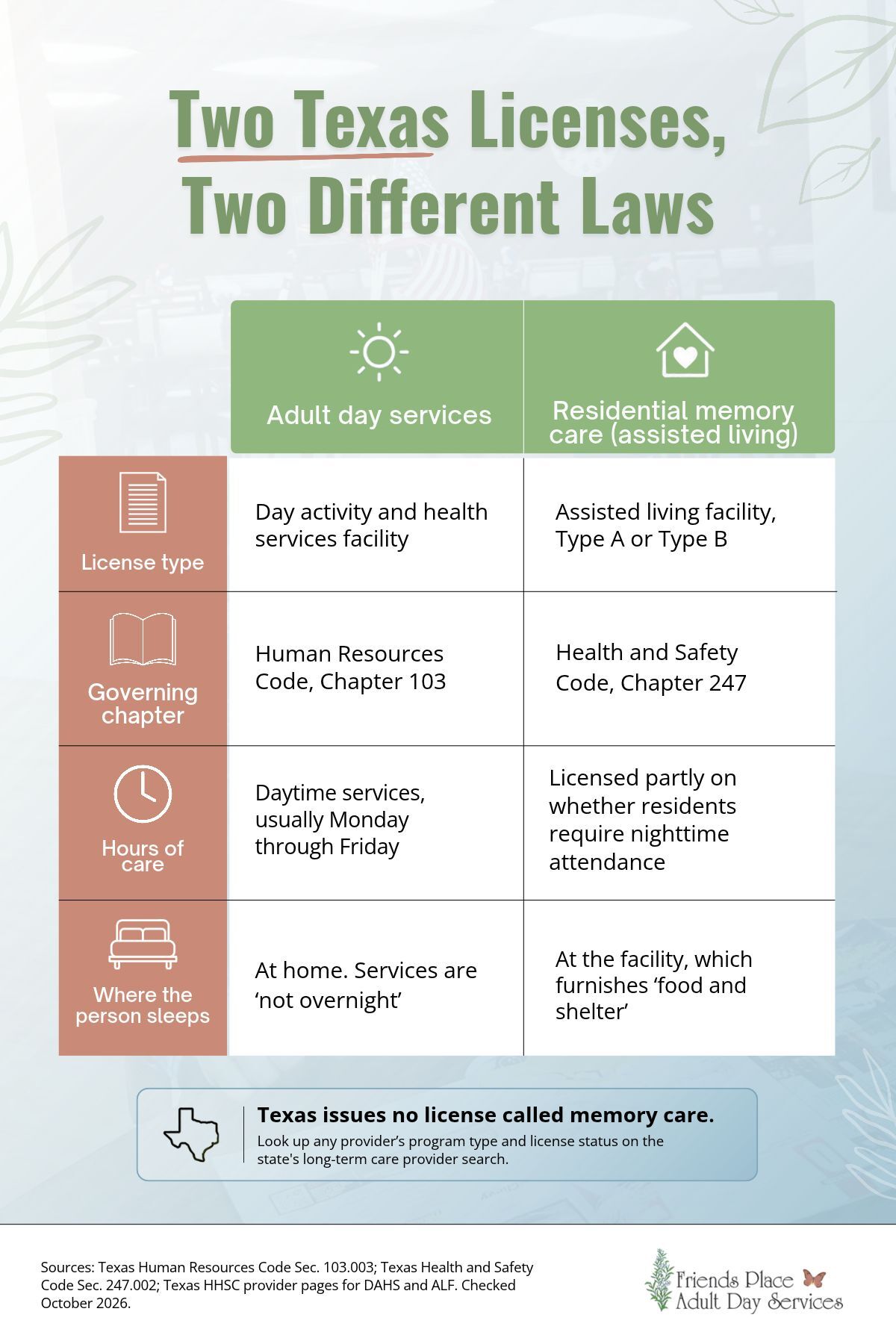
| Adult day services | Residential memory care in assisted living | |
|---|---|---|
| Name on the license | Day activity and health services facility | Assisted living facility, Type A or Type B |
| Governing chapter | Human Resources Code, Chapter 103 | Health and Safety Code, Chapter 247 |
| State rules HHSC lists | 26 TAC Chapter 559 | 26 TAC Chapter 553 |
| Hours of care | “daytime services, usually Monday through Friday” | Licensed partly on whether residents “require nighttime attendance” |
| Where the person sleeps | At home. Services are “not overnight” | At the facility, which furnishes “food and shelter” |
| Health oversight | “A licensed nurse must oversee the services” | Personal care or medication administration, with skilled nursing for limited purposes |
| Alzheimer’s classification | None in the chapter | Section 247.029 |
| License term | Three years | Three years |
| Routine inspection | Every two years | At least every two years |
What Chapter 103 says about a day program
Chapter 103 of the Human Resources Code is short, and Section 103.003 carries the definition that matters. A day activity and health services facility provides services “on a daily or regular basis but not overnight to four or more elderly persons or persons with disabilities” who are not related to the owner. The program inside it is described as structured, built around an individual plan of care, and delivered “in a protective setting.”
The Legislature also wrote down why the chapter exists. In Section 103.001, the stated aim is supervision for elderly people and people with disabilities “while enabling them to remain in a family environment and affording the family a measure of normality in its daily activities.”
That is the Legislature’s stated purpose for the law. It is not a promise about any one person, and we do not treat it as one.
HHSC’s provider page for day activity and health services fills in the practical side: “daytime services, usually Monday through Friday, for adults age 18 or older who live in the community,” with a licensed nurse overseeing them. Its list of what a program may include covers a noon meal and snacks, nursing care, personal care, and social, educational, and recreational activities.
What Chapter 247 says about assisted living
Chapter 247 of the Health and Safety Code, the Assisted Living Facility Licensing Act, starts from a different sentence. An assisted living facility “furnishes, in one or more facilities, food and shelter to four or more persons who are unrelated to the proprietor” and provides personal care services or the administration of medication.
Food and shelter. That phrase is the whole difference, and it is worth noticing what the chapter does not say: the words “overnight” and “24-hour” appear nowhere in it. Living there is assumed by the definition.
HHSC’s provider page for assisted living facilities explains how the license then splits in two. The agency licenses these facilities by residents’ “physical and mental ability to leave the facility in an emergency and whether they require nighttime attendance.”
- A Type A facility is for residents who “do not require routine attendance during sleeping hours and are capable of following directions in an emergency.”
- A Type B facility is for residents who “require staff assistance to leave the facility and are not capable of following directions in an emergency and require nighttime attendance.”
The third chapter, for nursing facilities
A plain caveat belongs here. This article compares the day license with the assisted living license. Nursing facilities also use the phrase memory care, and they are licensed under Health and Safety Code Chapter 242.
That chapter has its own version of the same idea. Its Section 242.040 sets up a certification for facilities that meet state standards for the specialized care of people with Alzheimer’s disease, says certification is not required to provide that care, and bars a facility from advertising that it is certified unless it is. Section 242.0405 adds a written notice for any nursing facility promoting “memory care services,” the same phrase Chapter 247 uses. Chapter 103, the day chapter, never uses it.
What Does “Memory Care” Mean on a Texas License?
Nothing by itself, because no Texas license carries that name. The closest thing in law is the Alzheimer’s classification in Section 247.029 of the Health and Safety Code, which tells the state to establish “a classification and license for a facility that advertises, markets, or otherwise promotes” personal care for residents with Alzheimer’s disease or related disorders. The same subsection adds that a facility “is not required to be classified under this section to provide care or treatment” to those residents.
Read those two sentences together, and you get the practical point. An assisted living facility can care for people with dementia with or without the classification, so the word on the sign does not tell you which kind you are standing in.
The chapter then gives families several ways to find out:
- The consumer disclosure statement: Section 247.026 requires a facility to give one to each prospective resident or their representative, and it must say whether the facility holds the Section 247.029 classification.
- The written notice: Under Section 247.0295, a facility promoting that it provides “memory care services” must tell each resident in writing whether it holds that classification or not.
- The number in the advertisement: Section 247.026 also requires a facility to use its license number or a state-issued facility identification number in all advertisements and promotional materials.
One more section is worth knowing, and it is Section 247.0291, which covers assisted living facilities that care for residents with Alzheimer’s disease without the classification. Each direct service staff member there has to complete four hours of training and pass a competency-based evaluation before providing direct care to those residents.
None of this is a ranking. It is a way of reading what a provider is, in the state’s vocabulary instead of a brochure’s.
Is There Such a Thing as Daytime Assisted Living?
Not as a Texas license. Under Section 247.021, a person operating a facility that is not required to be licensed under Chapter 247 “may not use the term ‘assisted living'” for the facility or its services unless they choose to obtain that license.
A day program is licensed under a different chapter, so the honest name for what people mean by the phrase is adult day services. We do not call ourselves assisted living, daytime or otherwise.
How to Look a Provider Up on the State’s Own Search
The lookup is public and needs no account. These steps reflect the search page as it worked on October 12, 2026.
- Open the long-term care provider search on the Texas Unified Licensure Information Portal, the tool HHSC’s own long-term care page sends families to.
- Choose a program type. “Day Activity and Health Services (DAHS)” is the day license. “Assisted Living Facilities (ALF)” is the residential one, and “Nursing Facilities (NF)” is the third.
- Type a city or a ZIP code, or the provider’s name if you have it.
- Read the Status column before anything else. On that one day, it showed “LICENSED,” “NOT LICENSED,” “LICENSED – TEMPORARY,” and “ENFORCEMENT ACTION PEND” across different records, so appearing in the results is not the same as holding a license.
- Click the provider’s name. The detail page shows program type, service type, license status, and a line for Alzheimer certification, with tabs for inspections and enforcement actions.
Here is what our own records look like, so you know what a day license reads like. Both our Richardson center and our DeSoto center come back with the status “LICENSED,” the service type “DAY CARE,” and the program type “DAHS.”
Two details trip people up, and both are local.
Search by city, not by county alone
The results table shows a provider’s registered county, and city limits do not follow county lines here. Assisted living records for Frisco came back registered in both Collin and Denton counties, and Richardson’s in both Dallas and Collin. Our Richardson center is registered in Dallas County, so families who drive in from Plano and filter to Collin County alone will not find us in the list. A Collin-only day search on the same date returned five records, and ours was not among them.
Read the Alzheimer certification line in context
On our Richardson record, that line reads “No,” which surprises people, since memory loss is the reason our program exists. The explanation is in the statutes. Chapter 103 gives a day facility no Alzheimer’s classification to apply for; the words Alzheimer’s, dementia and memory do not appear anywhere in it. The classification lives in Chapter 247, and the certification in Chapter 242, and both are residential.
So on a day program’s record, a “No” on that line tells you nothing about dementia experience. Ask the center directly. On an assisted living record, treat it as the line to compare with the facility’s own consumer disclosure statement, which must say whether it holds the Section 247.029 classification.
Who Each Setting Is Described For, in the State’s Words
We are not going to tell you which one your parent or spouse needs. That depends on the person, the household, and what their physician says, and no statute answers it. What we can do is put the state’s own descriptions next to each other.
For day services, HHSC writes that they are for adults “who live in the community,” and that these services “can help people stay at home and may prevent the need to move to a nursing home or other facility.” That is the agency’s sentence, with the agency’s “may” in it. We quote it; we do not promise it.
For assisted living, HHSC describes “individualized health and personal care assistance in a homelike setting with an emphasis on personal dignity, autonomy, independence and privacy.” The Type B wording above adds the state’s description of a resident who needs help leaving in an emergency and attendance at night.
Seen that way, the two licenses answer different questions. One covers the daytime of a person who goes home to sleep. The other covers a person’s whole day and night.
A day license cannot stretch across a night, whatever the family needs that week. When the need is a few nights away, the options are residential, and our guide to planning respite around the length of break you need walks through them. Our McKinney page takes up the same day care or memory care question for one town, with the drive included.
What Medicare Says About Paying for Either One
On this point, both settings land in the same place. Medicare’s long-term care coverage is headed: “Medicare doesn’t pay for long-term care,” and its examples of long-term care include adult day health care. The page says Medicare and most health insurance, including Medigap, “don’t pay for long-term care services, including care in a nursing home or in the community.”
The same page names two other routes: Medicaid, “if you meet eligibility requirements in your state,” and private long-term care insurance. Whether either applies to a particular person is a question for the program or the insurer, and we will not guess at it here. At Friends Place, our Richardson and Plano centers accept long-term care insurance but do not accept Medicaid, Medicare or other health insurance.
What Neither License Settles
A license tells you a provider cleared the state’s requirements for its type. The assisted living chapter says so in plain terms: its rules “establish minimum acceptable levels of care.” Chapter 103 has the commissioner set standards for health and welfare, supervision, staffing, and food service, and requires an on-site inspection before a day license is issued.
Both chapters put the routine inspection on a two-year cycle, and Chapter 103 lets any person request an inspection by writing to the commission about an alleged violation. None of that tells you how a Tuesday afternoon feels in a particular building.
The state says as much. The help page for its provider search opens with the reminder that “nothing can replace visiting a facility or meeting with a provider in person.”
So take the record with you and ask about what it leaves out:
- Who is in the room during the hardest hour of the day, and how many people are they responsible for?
- What dementia training have the direct care staff had, and when?
- What happens when someone has a difficult afternoon, and how would the family hear about it?
- For a residential provider, may we see the consumer disclosure statement before we decide?
Our answers to the first questions are on our site: a licensed nurse on duty each day and a staff-to-member ratio of one to five. Those are our choices, and you should hear every provider’s own.
There is one question no license reaches. Many families get stuck before any of this, on whether the person will agree to go at all, and we wrote about raising day services with someone who says they do not need them for that reason.
Look Up the License Before You Tour a Day Program or Memory Care
Before the next visit, wherever it is, run the provider’s name through the state search and write down three things: the program type, the license status, and, for a residential provider, whether it holds the Alzheimer’s classification. A few minutes at the kitchen table in Mesquite or Duncanville will show what you are actually comparing: two day programs, two residential ones, or one of each.
If a day program is what you are looking for, Friends Place Adult Day Services is licensed by the Texas Health and Human Services Commission as exactly that, and our members go home every evening. Look us up first. Then come see us on a weekday while the program is running and bring the questions above.
Adult day care is licensed under Human Resources Code Chapter 103 and, by definition, is “not overnight.” Residential memory care is usually an assisted living facility under Health and Safety Code Chapter 247, which furnishes food and shelter. One covers daytime; the other is where a person lives.
No license carries that name. Section 247.029 of the Health and Safety Code creates an Alzheimer’s classification for assisted living facilities that advertise that care, and Section 242.040 creates a certification for nursing facilities. A facility may care for people with dementia without either one.
Not under a day license. Section 103.003 of the Human Resources Code defines a day activity and health services facility as providing services “on a daily or regular basis but not overnight.” Overnight care in Texas falls under a residential license such as assisted living.
Search its name on the state’s long-term care provider search, choose assisted living as the program type, and open the detail page, which has a line for Alzheimer certification. The facility’s consumer disclosure statement must also say whether it holds the Section 247.029 classification.
Medicare’s long-term care page says “Medicare doesn’t pay for long-term care” and lists adult day health care among its examples. The page points to Medicaid, for people who meet their state’s eligibility requirements, and to private long-term care insurance as other routes. Friends Place accepts long-term care insurance at our Richardson and Plano centers, but not Medicaid, Medicare or other health insurance.